



By Rosie Whittle, PhD, University of Arkansas
Introduction to Japanese quail
Japanese quail (Corturnix corturnix japonica) are the smallest farmed birds and contribute to approximately 10% and 0.2% of the global table egg and meat markets (Lukanov, 2019). They were domesticated from Japanese quail endemic to East Asia, including Japan, South Korea, China and Mongolia. They are known to migrate up to 1000km between overwintering and breeding regions. Domesticated Japanese quail were selected for both egg and meat production. Quail hens start laying at 7 weeks, and lay up to 260 eggs a year. Meat processing occurs at around 5 weeks making the reproductive and production cycle short (Prabakaran, 2003), Females are generally larger than males and have speckled feathers, whereas males have fawn brown chest feathers (Prabakaran, 2003).
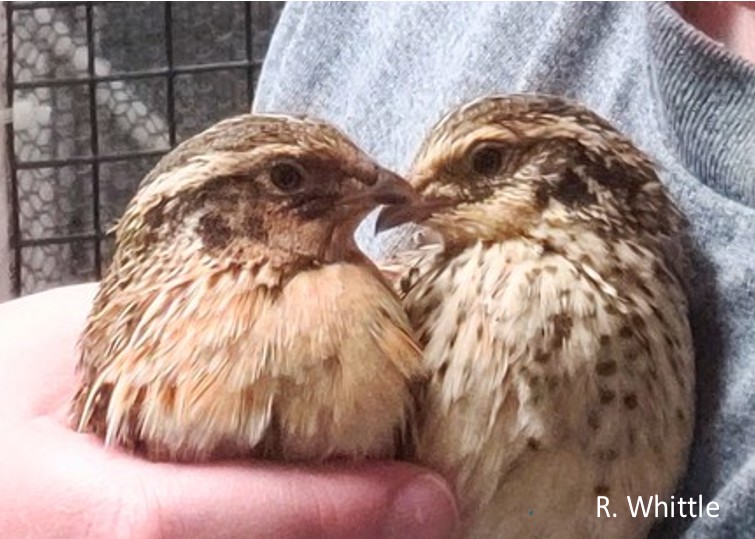
Male left, female right
Housing and management
Guidelines for quail management or housing are sparse. Compared to other poultry, there is little research on how housing conditions affect behavior and welfare. Commercial quail are typically kept in either cage systems or floor pens. Raising quail in caged systems reduces feed conversion ratio and decreases contact with litter which can reduce disease risk, compared to quail on litter. However, there do appear to be benefits of raising quail on litter including higher body weights, earlier onset of lay, and higher fertility and hatchability (El-Sheikh et al., 2016). Quail mortality can be around 2% but is variable and dependent on proper management (Edwin, 2020).
Stocking density
There is little information on the ideal stocking density for quail (Jansson et al., 2025). However, the Guide for the Care and Use of Agricultural Animals in Research and Teaching (Ag Guide, 2020) recommends the minimum stocking density for caged quail as 125cm2/bird and 145cm2 in floor pens. The Food and Agricultural Organization (FAO, 2003), recommends 180cm2 for meat quail and 225cm2 for egg producing hens. Quail may benefit from decreased stocking density up to 233cm2, which is associated with increased body weight, feed intake, egg production, and antibody production. In addition, lowering stocking density decreases mortality, stress hormone levels, respiratory rate and body temperature, indicating that allowing more space per quail than currently recommended decreases stress levels (El-Shafei et al., 2012).
Lighting
Lighting regimes
Day length appears to have little effect on production factors for quails raised for meat (Aguiar et al., 2017). However, hens raised for egg production have increased egg production with 14 hours of light compared to 15-17 hours of light (Molino et al., 2015), although 16 hours of light is generally recommended for egg production (Ag Guide, 2020).
Light intensity
Interestingly, light intensities between 5 and 22 lux showed similar production outcomes (Molino et al., 2015), suggesting that quail may not be sensitive to specific light intensities, although literature generally agrees that 22lux is recommended for quail (Molino et al., 2015; Ag Guide, 2020).
Comparing light sources
When it comes to light sources, some research suggests that LED lights resulted in earlier onset of lay, increased body weight and higher reproductive hormone levels than incandescent or fluorescent light (Ahmad et al., 2016). However, other research showed no difference between the three light sources but recommend LED lights because they are more energy efficient (Molino et al., 2016),
Light color
Light color is also being explored in quail. White light increases egg production and reproductive traits compared to blue, green or red light (Bobadilla-Mendez et al., 2016). Quail raised under blue light were least anxious in a new environment, and blue and white light reduced stress hormone levels compared with green and red light (Elbaz et al., 2023).
Flooring
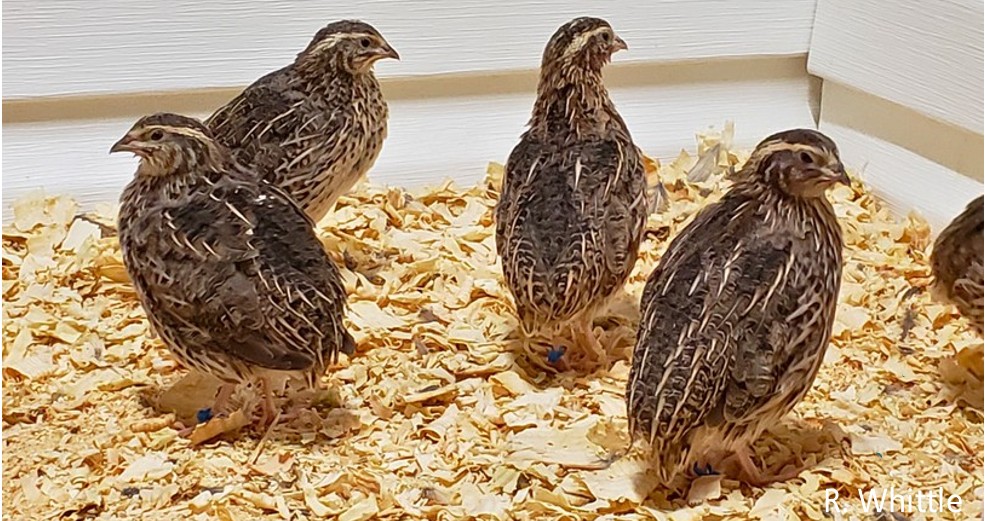
Many quail are kept on wire flooring, but there may be benefits of raising quail on litter. However, there is no behavior and welfare research directly comparing litter and wired floors. Quail are naturally foragers, spending a large portion of their time walking and searching for food (24%), foraging, scratching and pecking (8%), and ingesting food (4%) (Schmid and Wechsler, 1997). They are motivated to dustbathe and when litter is not provided and will attempt to dustbathe on wire floors (sham dustbathing). Quail dustbathe for up to 6% of the light period. Dustbathing also appears to follow a diurnal rhythm, with 180% more dustbathing observed in the afternoon than in the morning (Statkeiwitz and Schein, 1980). Litter type may also affect quail behavior and welfare. Quail raised on sawdust showed more resting and comfort behaviors than those raised on sand, rice hulls or dried mud (Mohammed et al., 2017). Quail had the lowest mortality (0.5%) on sawdust compared to other substrates (1.25-1.50%), the best plumage condition and showed no leg issues where the other litter types had up to a 4% prevalence of footpad dermatitis (Mohammed et al., 2017).
Cover
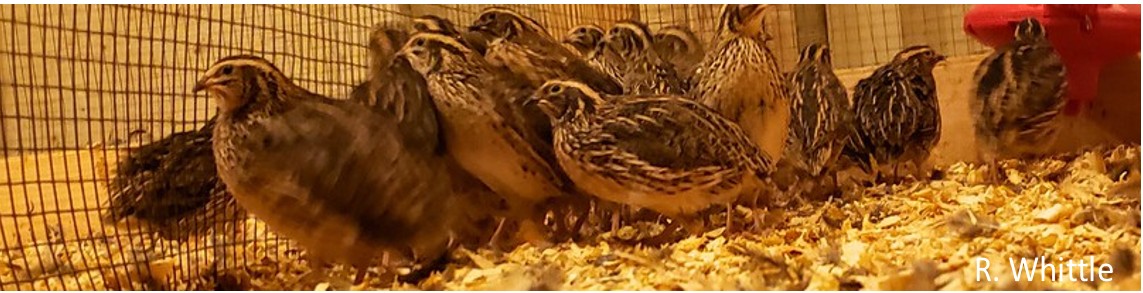
Quail naturally live amongst dense vegetation. They are not motivated to seek elevated structures such as perches and spend a high proportion of time (~50%) under covered areas when they are available (Buchwalder and Wechsler, 1997). Providing covered areas that quail can offer a safe retreat. When threatened quail seek cover to avoid predation, when they are unable to reach cover, they perform a secondary defense which is to fly up as high as they can, that can lead to injuries if the ceiling is too low. Quail perform significantly less flight behavior after a predator stimulus when adequate cover is provided (Buchwalder and Wechsler, 1997).
Nesting
Quail are generally housed without nestboxes. However, research suggests that quail without nestboxes show pre-lay restlessness which could be a sign of frustration (Schmid and Wechsler, 1998). Quail prefer to lay in nestboxes, with up to 90% of eggs laid in provided nestboxes (Schmid and Wechsler, 1998). They show strong preference for nestboxes that are enclosed on all sides, with a single small opening; 79% of all eggs were laid in such a nestbox compared with nestboxes with open or mesh sides (Buchwalder and Wechsler, 1997). Quail prefer to lay eggs in corner nests (79%) and nests that contain chopped straw over hay, and hay over artificial turf (Schmid and Wechsler, 1998). Research to assess motivation to access nesting areas and willingness to share nests has not been conducted. Therefore, the optimal number of nests that should be provided for the number of quail is unknown.
Managing social interactions
Quail are social with a dominance hierarchy (Boag, 1982). Wild quail are found in small breeding flocks or during migration they are found in much larger flocks (Lukanov and Pavlova, 2020). In commercial settings, managing mixed-group compositions are important to reduce agonistic behaviors. Aggressive behavior is rarely seen in all-hen layer flocks or meat flocks slaughtered before or around sexual maturity. Typically, aggression occurs between adult males.
Sexual aggression towards females is also common with one study showing 21% of males displaying strong aggression towards females, with no benefit to mating success compared to non-aggressive males (Pellegrini et al., 2019). The FAO (2020) recommends 1 male for every 3 females (1:3); however, in one study fertility only significantly diminished with a 1:20 ratio (Wechler and Schmid, 1998). A ratio of 1:6-8 is suggested to optimize fertility and reduce aggression (Shanaway 1994).
Key welfare issues
Flight injuries
Flight or fear responses causing quail to fly up can result in traumatic head injuries (Cheng et al., 2010). This is most common in caged systems. One way to prevent this is to have a lower cage height that prevents acceleration upwards. In floor systems, ceilings should be heigh enough to allow full flight height (Buchwalder and Wechsler, 1997).
Injurious aggressive pecking
Aggression between males or towards females and can result in soft tissue damage to the head and eyes (Figure 1). Methods to reduce injurious pecking include beak trimming, anti-pecking devices, separation walls, removal of aggressive birds, dimming lights, and increasing the female-to-male ratio. However, these methods have minimal success. Even under low lux (1-5) injured males had to be removed and it was suggested that multi-male breeding groups should be avoided (Wechsler and Schmid, 1998).
Feather pecking
Feather pecking (Figure 1) is observed in quail with one study noting 29% of caged quail showed signs of feather pecking on their backs (Cruvinel et al., 2020). However, others note that the prevalence was low with only 0.5-2 occurrences of feather pecking per hour (Miller and Mench, 2006).
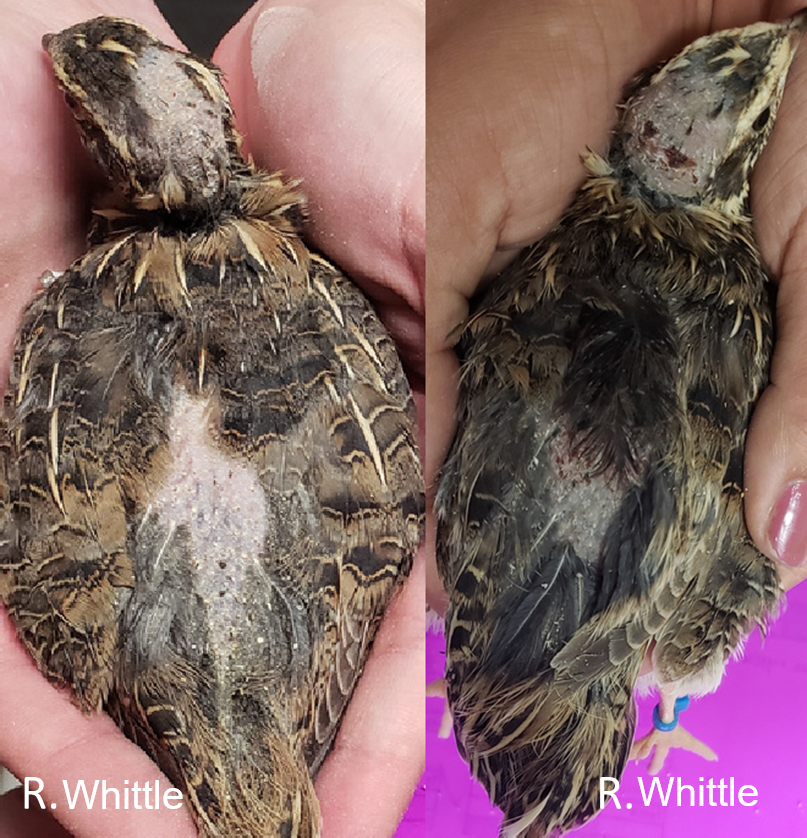
Figure 1: Quail hens with feather loss and scabs to the head due to male aggression and back from feather pecking.
Keel bone damage
Despite quail having a larger egg-to-body mass ratio than chickens, keel bone damage appears less frequent in quail than laying hens with reported prevalence of 5.8%. They do, however, show a high prevalence of keel bone deviations(86%) (Hildebrand et al., 2023).
Summary
- Fast-growing, dual-purpose species: Japanese quail mature quickly—hens lay at 7 weeks and meat birds finish by 5 weeks—making them highly efficient for egg and meat
- Space needs are critical: Higher stocking densities reduce welfare and performance, while increased space per bird improves growth, egg output, immune function, and lowers stress and Ceiling height is important to prevent flight injuries.
- Lighting affects welfare and production: Layers perform best with ~14–16 hours of light; white light and LEDs generally support better production and reduced
- Litter, cover, and nestboxes enhance welfare: Quail are ground-dwelling foragers that value dustbathing and hiding Sawdust litter, covered spaces, and fully enclosed nestboxes support natural behaviors and reduce fear and injuries.
- Social management matters: Male-driven aggression and injurious pecking can be issues; optimal male:female ratios (1:6–8) reduce aggression while maintaining fertility, and careful group management is essential.
References
- Lukanov, H. (2019). Domestic quail (Coturnix japonica domestica), is there such farm animal? World’s Poultry Science Association, 75: 547-557. https://doi.org/10.1017/S0043933919000631
- Edwin, C. (2020). Commercial Japanese quail production and disease management. International Journal of Science, Environment and Technology, 9(3): 416-422.
- El-Shafei, A., Abdel-Azeem, A. F., Abdullaha, E. A. (2012). Stocking density effects on performance and physiological changes of laying Japanese quail. Journal of Animal and Poultry Production, 3 (8): 379-398. https://doi.org/10.21608/jappmu.2012.82943
- El-Sheikh, T. M., Essa, N M., Abdel-Kareem, A. A. A., Elsagheer, M. A. (2016). Evaluation of productive and reproductive performance of Japanese quails in floor pens and conventional cages with different stocking Egyptian Poultry Science Journal, 36(3): 669-683. https://doi.org/10.21608/epsj.2016.168800
- Schmid, , Wechsler, B. (1997). Behaviour of Japanese quail (Coturnix japonica) kept in semi-natural aviaries. Applied Animal Behaviour Science, 55: 103-112. https://doi.org/10.1016/S0168-1591(97)00039-7
- Prabakaran, R. (2003). Good practices in planning and management of integrated commercial poultry production in South Asia. Food and Agricultural Organization of the United Nations. https://www.fao.org/4/y4991e/y4991e00.pdf
- Ag Guide, 2020. Guide for the Care and Use of Agricultural Animals in Research and Teaching. Fourth Edition. https://www.adsa.org/Portals/0/SiteContent/docs/AgGuide4th/Ag_Guide_4th_ed.pdf
- Bobadilla-Mendez, F., Rojas-Granados, C. P., Andrade, E. F., Retes, P. L., Ferreira, L. G., Alvarenga, R. R., Rogriduez-Grl, J. E., Fassani, E. J., Zangeronimo, M. G. (2016). Effect of different light sources on reproductive anatomy and physiology of Japanese quail (Coturnix coturnix japonica). Animal Reproduction Science, 168: 50-56. dx.doi.org/10.1016/j.anireprosci.2016.02.025
- Bobadilla-Mendez, F., Rojas-Granados, C. P., Andrade, E. F., Retes, P. L., Ferreira, L. G., Alvarenga, R. R., Rogriduez-Grl, J. E., Fassani, E. J., Zangeronimo, M. G. (2016). Effect of different light sources on reproductive anatomy and physiology of Japanese quail (Coturnix coturnix japonica). Animal Reproduction Science, 168: 50-56. dx.doi.org/10.1016/j.anireprosci.2016.02.025
- Elbaz, A., Fares, I. M., Ahmed, A. M., Hegab, I. M. (2023). Different LED light colors modify behavior, physiology, and hypothalamic CRF and NPY mRNA expression in Japanese quail (Coturnix coturnix japonica). Applied Animal Behaviour Science, 261: 105902. https://doi.org/10.1016/j.applanim.2023.105902
- Ahmad, , Sharif, M., Ashraf, M., Riaz,M., Shoaib, M., Siddique, T., Ahmed, A., Sheir, A. H., Yaseen, M. A., Hamid, M. M. A. (2016). Effect of different light sources on reproductive anatomy and physiology of Japanese quail (Coturnix coturnix japonica). Animal Reproduction Science, 168: 50-56.
- Molino, B., Garcia, E. A., Santos, G. C., Vieira Filho, J. A., Baldo, G. A. A., Almeida Paz, I. C. L. (2015). Photostimulation of Japanese quail. Poultry Science, 94: 156-161. http://dx.doi.org/10.3382/ps/peu039
- Aguiar, G. C., Freitas, E. R., Watanabe, P. H., Figueiredo, C. W. S., Silva, L. P., Nascimento, G. A. J., Lima, R. C., Nepomuceno, R. C., Sá, N. L. (2017). Lighting programs for male and female meat quails (Coturnix coturnix) raised in equatorial Poultry Science, 96: 3122-3127.
- Buchwalder, , Wechsler, B. (1997). The effect of cover on the behaviour of Japanese quail (Coturnix japonica). Applied Animal Behaviour Science, 54: 335-343. https://doi.org/10.1016/S0168-1591(97)00031-2
- Schmid, , Wechsler, B. (1997). Behaviour of Japanese quail (Corturnix japonica) kept in semi-natural aviaries. Applied Animal Behaviour Science, 55: 103-112. https://doi.org/10.1016/S0168-1591(97)00039-7
- Schmid, , Wechsler, B. (1998). Identification of key nest site stimuli for Japanese quail (Coturnix japonica). Applied Animal Behaviour Science, 57(1-2): 145-156
- Statkeiwitz, R., Schein, M. W. (1980). Variability and periodicity of dustbathing behaviour in Japanese quail (Coturnix coturnix japonica). Animal Behaviour, 28: 462-467. https://doi.org/10.1016/S0003-3472(80)80053-4
- Mohammed, H. H., Said, E. N. Abdel-Hamid, S. E. L. (2017). Impact of different litter materials on behaviour, growth performance, feet health and plumage score of Japanese quail (Coturnix japonica). European Poultry Science, 81: 1-9. https://doi.org/10.1399/eps.2017.172
- Boag, A. (1982). How dominance status of adult Japanese quail influences the viability and dominance status of their offspring. Canadian Journal of Zoology, 60(8): 1885-1891 https://doi.org/10.1139/z82-245
- Lukanov, , Pavlova, I. (2020). Domestication changes in Japanese quail (Corturnix japonica): a review. World’s Poultry Science Journal, 76(4): 787-801. https://doi.org/10.1080/00439339.2020.1823303
- Pellegrini, S., Condat, L., Caliva, J. M., Marin, R. H., Guzman, D. A. (2019). Can Japanses quail male aggressions toward a female cage-mates predict aggressiveness toward unknown Livestock Science, 222: 65-70.
- Shanaway, M. (1994) Quail production systems: a review. Food and Agriculture Organization of the United Nations, Rome
- Cheng, K. M., Bennett, D. C., Mills, A. D. (2010). The Japanese quail. In The UFAW Handbook on the Care and Management of Laboratory and Other Research Animals (eds R. Hubrecht and J Kirkwood) https://doi.org/10.1002/9781444318777.ch42
- Wechsler, , Schmid, I. (1998). Aggressive pecking by males in breeding groups of Japanese quail (Coturnix japonica). British Poultry Science, 39: 333-339. https://doi.org/10.1080/00071669888863
- Cruvinel, J. M., Montenegro, A. T., Ouros, C. C. dos, Alves, K. de S., Ribeiro, G. C., Santos, T. S. dos, Molino, A. de B., & Garcia, E. A. (2022). Beak trimming in Japanese quails at initial phase is an alternative to reduce the negative effects of feather Acta Scientiarum. Animal Sciences, 44(1), e54129. https://doi.org/10.4025/actascianimsci.v44i1.54129
- Miller, A., Mench, J. A. Differential effects of 4 types of environmental enrichment on aggressive pecking, feather pecking, feather loss, food wastage and productivity in Japanese quail, British Poultry Science, 47(6): 646-658 https://doi.org/10.1080/00071660601084333
- Hildebrand, L., Gerloff, C., Winkler, B., Eusemann, B. K., Kemper, N., Petow, S. (2024). Japanese quails (Corturnix japonica) show kell bone damage during the laying period – a radiography study. Frontiers in Physiology, 15: 1368382. https://doi.org/10.3389/fphys.2024.1368382
To view all issues of Poultry Press, click here.
Editor’s note: Content on Modern Poultry’s Industry Insights pages is provided and/or commissioned by our sponsors, who assume full responsibility for its accuracy and compliance.