



Main photo courtesy of W.A. Dozier
By David L. Wicker, PhD, industry consultant, Gainesville, Georgia and W.A. Dozier, III, PhD, Department of Poultry Science, Auburn University and Alabama Cooperative Extension System
The poultry industry faces increased challenges to improve broiler-production efficiency with fewer inputs. The economic success of the grower and integrator depends on management practices, bird growth, disease, morbidity and mortality, among other factors.
A lack of labor can lead to poor poultry-management practices, resulting in economic losses to the grower. Providing growers with technologies to supplement existing labor to improve bird movement and feed consumption, increase bodyweight uniformity and decrease mortality will strengthen the profitability of poultry farms.
Autonomous robots
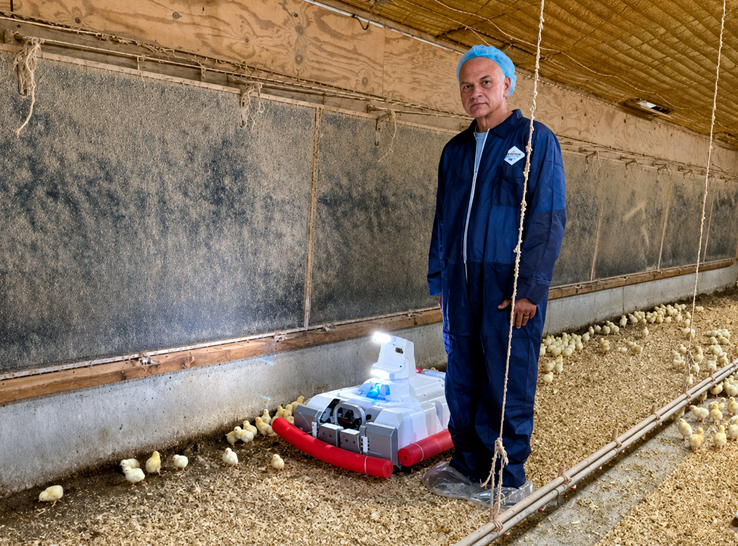
Apelie Robotics has developed a robot, AviSense, for broiler houses. AviSense is a mobile, autonomous robot that navigates poultry houses without human intervention. The dimensions of the robot are 27.6 × 29.5 × 33.5 inches, and it weighs approximately 53 pounds (24 kg). It operates on programmable routes throughout the house at variable speeds up to 0.3 feet per second and can function for approximately 10 hours when it autonomously recharges.
The system incorporates autonomous navigation technology with camera systems to monitor bird dispersion and bird movement. The robot contains sensors to collect data on humidity, air temperature and litter temperature at bird level per second via the programmable route it follows in the house (see main article image).
The robot is a mobile data-sensing platform at bird level that collects data throughout the house and transmits information in real time to a storage site. The farm manager can access data via communication with a mobile phone or computer. These real-time data support precision poultry management by the farm manager.
Robot benefits
The robot can potentially reduce the time required for pre-placement checks by providing information on mapping temperature and relative humidity profiles, as well as images of proper or improper house setup (Figure 1). During production, these data enable farm managers to detect and correct temperature/ventilation problems to improve house conditions and identify areas of potential welfare concern.
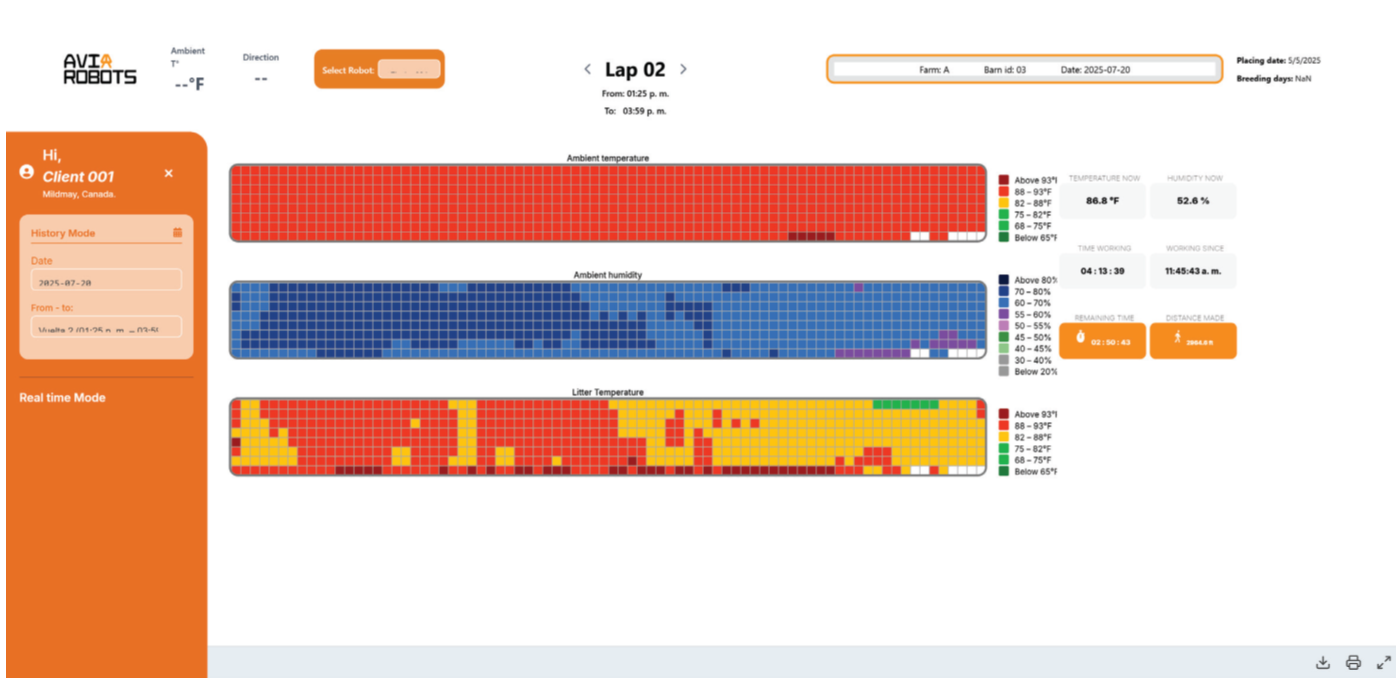
Figure 1. An example of a profile map displaying ambient temperature, relative humidity, litter temperature of the robot. This provides an indication of areas in the house that an equipment problem may be occurring. Click on image to enlarge.
The robot can stimulate chicks to move, encouraging feed and water consumption, particularly during brooding. Additionally, the robot can prompt older birds to move, potentially improving heat removal during times of high temperatures during summer production.
Field trials
A series of field trials has been conducted in Canada and the US to assess the effects of implementing an AviSense robot in broiler production on performance objectives and economic revenue.
Canada
Trial 1 was conducted from June to August of 2025, with one house of 32,000 broilers on a broiler farm; the house was divided by a lengthwise separation fence. The robot was placed in the house at day 10 and operated daily until marketing.
The average bodyweight of broilers in the house with the robot was 5.17 pounds (2.35 kg) and in the house without the robot, 5.24 pounds (2.37 kg). Bird rejection data showed a 3% rejection rate (1% at the farm and 2% during processing) for birds without a robot compared to a 1.6% rejection rate (0.8% at the farm and 0.8% during processing) for birds with a robot.
The decrease in rejection rates resulted in more saleable pounds of meat at the processing plant: 856 pounds (388 kg) at $0.91 per pound, totaling a $779 greater return for the side of the house with the robot.
A second trial at this farm was implemented from September to October 2025 using the same design and conditions. The area with no robot had an average weight of 4.41 pounds (2 kg) at 37 days of age, with a rejection rate of 1%. The side with the robot had an average weight of 4.67 pounds (2.12 kg), with a rejection rate of 0.62%.
With greater weights and lower rejection rates, an increase of 3,865 pounds (1,753 kg) of live weight transported to the processing plant was determined for two loads of broilers per treatment group. The increase of 3,865 pounds (1,753 kg) at $0.91 per pound translated into an increase in revenue of $3,517.15 for the side of the house equipped with the robot.
The trial had six loads of broilers. However, two loads of broilers subjected to the sides of the house with and without a robot were mixed and could not be used in the evaluation.
The third trial was conducted from August to September 2025 on a nearby farm with two paired houses for the test. Average bodyweight was slightly less for the house with the robot, at 5.10 pounds (2.31 kg), with a rejection rate of 1.91% and a feed-conversion ratio (FCR) of 1.457. The control house weighed 5.12 pounds (2.32 kg), with a rejection rate of 1.46% and FCR of 1.477.
Because of the higher rejection rate due to subcutaneous lesions and 0.54% higher mortality for the broilers in the robot house, the control house had 5,824 more pounds (2,641 kg) of live weight transported to the processing plant at $0.91 per pound, translating into an increase in revenue of $5,300. The robot house had a 0.02 better FCR, valued at $720 per house.
United States
A fourth trial was initiated in October 2025 on a farm in the southeastern US in an integrated broiler operation. House 1 was used as the test house with the robot starting on day of placement, and House 2 was used as the control house. In each house, chicks originated from the same breeder flocks.
House 1 with the robot had a weight of 7.69 pounds (3.49 kg) per bird at 47 days, with an FCR of 1.653 and a livability of 92.19%, for a total house weight of 194,967 pounds (88,435 kg). House 2 had a weight of 7.52 pounds (3.41 kg ) per bird at 47 days, with an FCR of 1.701 and a livability of 92.47%, for a total house weight of 191,226 pounds (86,739 kg). This farm experienced late-occurring kinky back and a higher-than-expected mortality rate, but the control house had a slightly higher livability percentage than the house using the robot.
The increase in bodyweight and feed conversion in House 1 with the robot reduced the grower’s cost per pound of meat compared with the control house. This lower cost increased the grower’s pay by $1,052 for the house with the robot.
The integrator would obtain a large return from more pounds of meat in the processing plant and a lower production cost due to the improved FCR. Standard costs were reduced by $0.0054 per pound in the robot house versus the control house.
For example, the integrator’s live cost could be reduced from $0.435 to $0.429 per pound of live weight produced. For every million birds placed with a final live weight of 6.5 pounds (2.95 kg), an economic return of $35,100 per week could be obtained due to live cost. An increase in total live weight delivered to the processing plant would improve its margins.
Conclusion
Based on these initial field trials, implementing a robot in broiler production led to improved economically important live-production metrics. The reduction in live-production costs due to increased bodyweight and decreased rejection rates can increase returns to the grower and integrator, with more pounds of weight, using Apelie robots during commercial production.
Additional field trials are being conducted in the US and Europe to further define the benefits of improved condemnations, bodyweights, feed conversion and bird welfare. These field trials indicate that robots are being used to reduce labor and return economic benefits to the grower and the integrator. Further improvements to the robots and additional trials will continue to refine these benefits of using robots in commercial poultry production.
Editor’s note: The views expressed in this article are solely those of the authors.
This article was submitted to Modern Poultry as an educational article by one of the co-authors, William Dozier, PhD, Auburn University, who actively participated in the US trials. All data were supplied by the integrator who owned the broilers. Neither Dozier nor Auburn University has a commercial stake in this technology. The co-author, David L. Wicker, PhD, is a retired former vice president of live operations for a US broiler integrator. He participated in the US trials and now consults with Apelie, the company that developed AviSense.