





By Richard Griffiths
Chief Executive
British Poultry Council
When an organization starts thinking about its future, the temptation is always there to disappear into a meeting room, write a strategy, polish the language, produce a diagram and then present the finished answer to everyone else. It is neat and efficient, but it also risks asking members to endorse a destination they had no real part in choosing.
At the 2026 International Poultry Welfare Alliance (IPWA) Poultry Sustainability & Welfare Summit in Atlanta, we tried something different. Instead of starting with a statement about where poultry welfare should be in 2050, we began with questions, large sheets of paper, a considerable number of Post-it notes and the collective experience of the people in the room.
Pondering changes
The starting question was deliberately broad: what changes will shape poultry production and poultry welfare between now and 2050?
The answers quickly spread beyond what we might traditionally describe as animal welfare. They included disease and HPAI, genetics, housing, stocking density, bird behavior and management, as well as climate change, water availability, global food security, changing demographics and labor shortages. Other responses included:
- AI
- Geopolitics
- Trade
- Regulation
- Consumer expectations
- Automation
- Cyber threats
- New technologies
- Alternative proteins
- Economics of keeping farms and businesses viable
Nobody was asked to construct a systems model, yet that is effectively what began to appear. Some of the changes listed above are happening around us and to us, including climate pressure, geopolitical instability, disease threats, demographic change and pressure on water and other resources. Others are responses we might develop, such as better technology, education, research, genetics, monitoring, automation, training, regulation and resilience planning.
The conversation therefore moved naturally from what might change to what the poultry sector might need to adapt to or develop the changes.
Impact on poultry welfare
We then asked a second question: which of these changes could most fundamentally influence poultry welfare?
Again, the answers resisted being squeezed into a traditional welfare box. People talked about AI, automation, cameras and sensors, improvements in ventilation and lighting, scientific research and genetics. Other answers included disease, training, skilled labor, financial investment, profitability, regulation and consumer understanding, as well as housing, bird handling, management and outcome-based approaches to welfare.
One participant suggested using AI to make best-practice training more consistent. Another highlighted the need to attract and develop the next generation of poultry workers. Others pointed to genetic selection for welfare characteristics, better equipment, research funding, data-driven management and the need to move beyond processes that reward checklist completion toward understanding what is actually happening to the bird.
Interconnected parts
The more we looked at the wall, the less it resembled a list of competing priorities and the more it began to look like parts of the same system. For example, good genetics can create healthier and more resilient birds, but genetics cannot indefinitely compensate for poor environments or poor management.
Better housing, ventilation, lighting and equipment can create the conditions for good welfare, but somebody still needs the skills and judgment to use them properly. Cameras and sensors can provide more information about birds, but that information is useful only if people and organizations can understand and act on it.
Finally, standards can create expectations, but they also need science, economics, training, incentives and credible ways to measure outcomes.
Emerging framework
From that discussion, something resembling a framework began to emerge (Figure 1). There appear to be five interconnected capabilities:
- Better birds, through genetics, health, disease resistance and appropriate growth.
- Better environments, through housing, ventilation, lighting, stocking density and opportunities to express important behaviors.
- Better people, through skills, training, management, judgment and workforce capability.
- Better information, through AI, sensors, cameras, data, monitoring and outcome measurement.
- Better systems, through standards, regulation, economics, research, incentives and communication.
At the center sits what all five support: better welfare outcomes.
Figure 1.
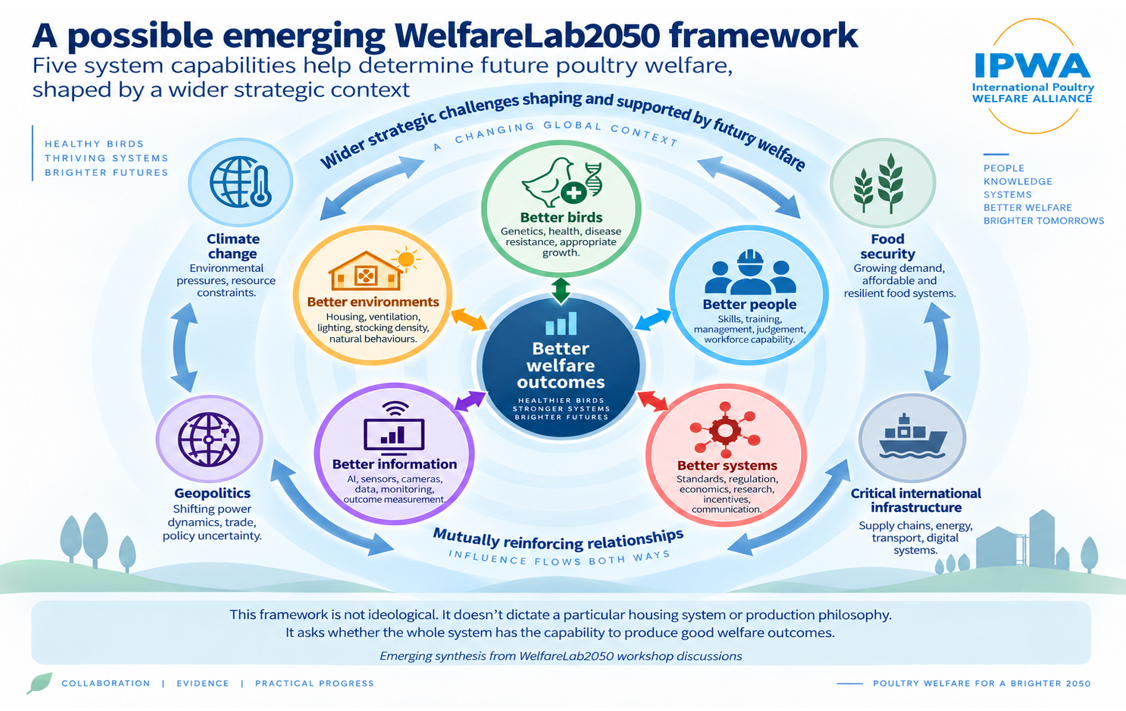
That structure does not begin by telling people which production system they must use, which technology they must purchase or which philosophy they must adopt. Rather, it asks whether the whole system can produce good welfare outcomes.
Poultry welfare also sits within a much wider environment. Climate change affects temperatures, water, feed, disease patterns, infrastructure and the people who work within the sector. Geopolitics can alter trade flows, energy availability, access to inputs and investment decisions. Critical international infrastructure determines whether feed moves, electricity flows, information travels and products reach consumers. Food security creates an obligation to provide nutritious, affordable food to a growing and changing population.
Those pressures affect welfare, but the relationship runs in the other direction, too. Healthy birds support more resilient food systems. Good welfare supports health and productive performance. Strong management builds capable businesses and skilled people. Better information helps detect problems earlier and supports more confident decision-making. Trusted welfare systems can strengthen public confidence in poultry production.
That means welfare is not added to a food system once everything else has been designed. It is part of the capability that allows the system itself to function well.
Moving forward
And that brings us back to the way the process began in Atlanta. None of this started with IPWA standing at the front of the room and explaining its new strategy. It started with members and participants writing things down, challenging one another, adding ideas, grouping and moving them, arguing for priorities, spotting connections and gradually producing a picture no individual at the table could have designed alone.
Academics saw things from one perspective, producers and companies from another, veterinarians and welfare specialists from another, while people involved in policy, assurance, technology, research and communication added still more. The diversity made the picture richer.
There is more work to do. Some ideas will survive further examination, and others will change. We will need evidence, challenges, research and discussion, and we will need to test whether the emerging framework works across species, production systems, countries, cultures, markets and regulatory environments. We will also need to hear from people who were not in the room.
Final thoughts
If IPWA is to help the global poultry sector think seriously about welfare towards 2050, its direction cannot belong only to a Board, secretariat, committee or consultant. It must also belong to the people who make IPWA what it is.
The Atlanta workshop was not a consultation on somebody else’s plan. It marked the beginning of building something together. The multi-colored notes on those walls represent members beginning to describe the future they believe is coming, the capabilities they think poultry will need and the role welfare should play within it.
IPWA’s future direction should not be something members are eventually asked to support. They should recognize it as their own.