



Main photo courtesy of Valco Industries
A wealth of university research and on-farm trials confirm broilers perform better under gradient LED lights compared with ceiling lights using LEDs, incandescent or compact fluorescent lighting.
The environment offers broilers an enriched environment, allowing them to convert feed to weight more efficiently. Studies have shown improvements of 3 points or more in feed conversion when the birds are raised in a gradient lighting environment versus standard lighting.
Optient lighting from ONCE® by Signify® is a lighting system built entirely around how a chicken sees the world. “Signify’s Optient is the first gradient lighting system designed specifically for poultry,” said Aaron Stephan, PhD, director of research and innovation at Signify.
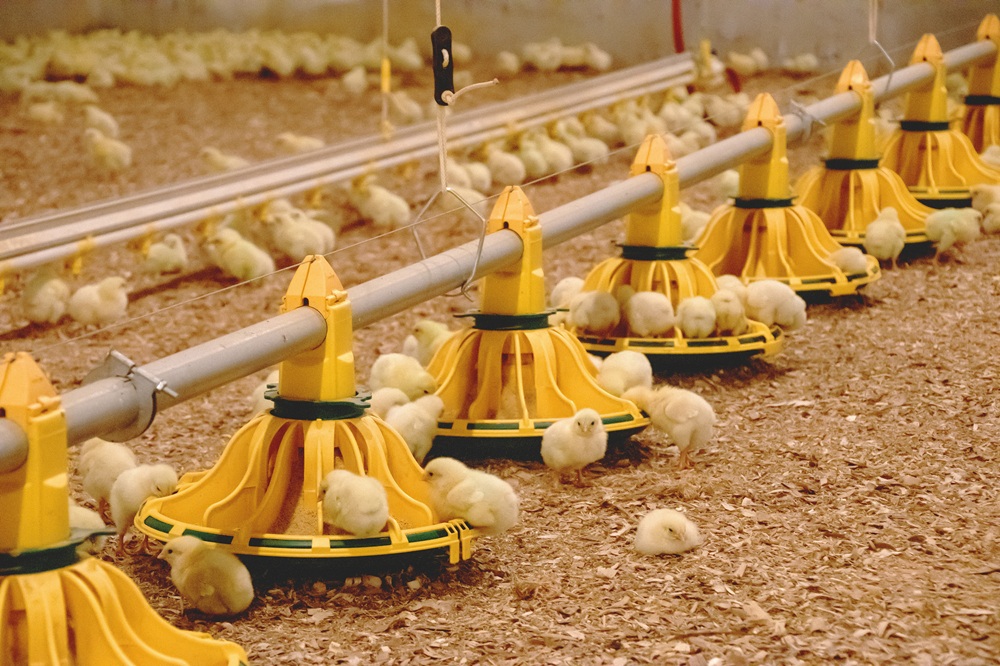
Photo courtesy of Valco Industries
Optient features
Optient lighting uses poultry-specific LED lights to accommodate the heightened photosensitivity of chickens. Field studies demonstrate that chickens overwhelmingly prefer high-intensity light for eating and low-intensity light for resting. Birds also prefer higher-intensity light when they are young and gradient lighting as they age.
“Optient gives chickens the ability to choose what lighting and intensity level is comfortable for them,” explains Logan Auker, VAL-CO engineer.
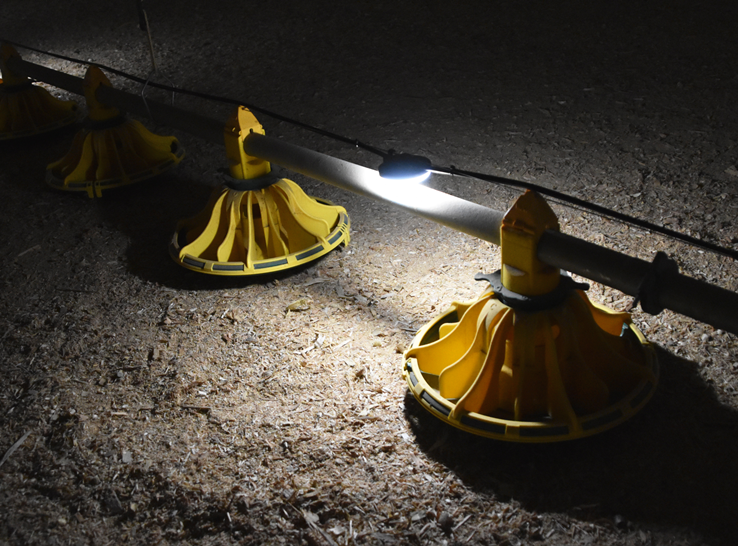
The lights are distributed and evenly spaced down the length of the feed line, providing a gradient of light across the barn and at various feed pans. Chickens can step into the light to eat, choosing which intensity is preferable, and then move back into lower light areas to rest, reflecting their natural behavior.
Designed for easy installation, Optient lighting attaches to existing cables already in the barn without the need for new conduit, according to Auker. The system is also energy efficient, with each LED light rated at 2 watts, compared to conventional LED ceiling lights at 10 watts.
“Dimming and lighting periods can be controlled through the whole house control system,” Auker adds. Engineered to work seamlessly with Optient lighting, the FUZE V grill-less pan feeder provides birds with easy access to feed from day one. It’s designed with high flood windows for excellent feed presentation, plus a feed-saver lip to prevent waste.
Research-based lighting
The Optient system is based on chicken-lighting research conducted at the University of Arkansas (UA). The university researchers measured chicken preferences for light intensity and type, then correlated the results with performance data and natural behaviors.
The research evaluated four lighting-intensity groups: 5 lux, 20 lux, natural light and gradient light (5 lux in dark areas to 40 lux next to feed lines).
The results showed significantly higher daily physical activity among chickens in the gradient-lighting group compared to the other groups. For example, electronic measurements detected birds were twice as active in the gradient light as birds in the constant 20-lux light group.
In addition, birds raised under Optient lighting produced significantly more dust-bathing holes, an indicator of improved welfare, than birds under other lighting systems. Their litter was also drier, consistent with lower stress and improved intestinal health.
Overall, flocks under gradient lighting outperformed those raised in other uniform lighting systems, according to UA researchers. They also showed increased flock movement, reduced stress and higher feed and water intake.
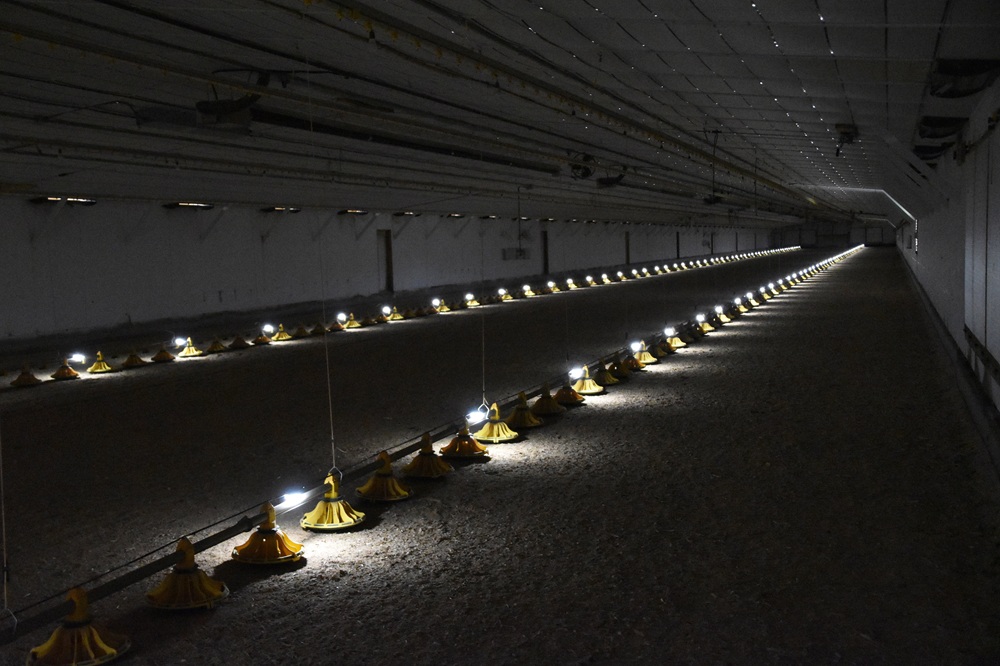
Photo courtesy of Valco Industries
Field trials affirm better feed efficiency
To support these findings, specialists with Signify’s Optient lighting conducted extensive field trials with seven integrators in the US and Ontario to compare 20 lux lighting to the Optient lighting system. The trials lasted 15 months and involved 10 farms for full production-level comparison.
Results across 24 field trials showed broilers raised under Optient lighting had a 3-point improvement in feed conversion — 1.75 vs. 1.78 — compared to birds under 20 lux lighting. A 3-point advantage equates to approximately 0.12 lb. of feed saved per bird, amounting to 8.25 tons of feed saved each year, assuming 25,000 birds per 66-day cycle and 5.5 cycles per year.
“The 3-point improvement in feed conversion from gradient lighting confirms the financial benefit of the Optient system,” Auker says.
“In addition, the system uses less power and promotes natural bird behavior,” he adds. “Overall, Optient lighting helps poultry operations raise healthy, profitable birds.”
Optient is available in the US and Canada through VAL-CO, a manufacturer and distributor of equipment and systems for poultry production. VAL-CO also offers the FUZE V feeder, which is fully compatible with Optient to help optimize grow-out margins.
To learn more about Optient lighting, visit the website Optient Gradient Lighting, call 800-998-2526 or send an email by clicking here.
Editor’s note: Content on Modern Poultry’s Industry Insights pages is provided and/or commissioned by our sponsors, who assume full responsibility for its accuracy and compliance.