





Field data from a large commercial layer enterprise confirm that Cargill’s Biostrong™ C-Protect — a postbiotic/phytogenic blend — supports improved livability in layers in the face of avian pathogenic Escherichia coli (APEC).
In a cage-free operation with 11 million birds, mortalities in APEC-challenged flocks fell more than 60% when the product was integrated into pullet diets and fed through peak production, consistent with earlier experimental results.
“APEC poses a major threat to layer operations, resulting in decreased egg production, increased bird mortality and significant economic losses. For cage-free producers, where birds face heightened exposure risks, the challenge is even greater,” said Mark Farmer, PhD, a nutritionist at Cargill.
“With antibiotics restricted in layers and vaccine efficacy waning over time, the industry urgently needs effective alternatives. These field observations confirm that Biostrong C-Protect holds up under real-world conditions, offering a reliable, sustainable solution that helps mitigate the toll of APEC on layer health, productivity and well-being.”
Reduced mortality
For the trial, the product was adopted in phases, initially looking at breed-level effects in flocks of Lohmann Browns and Lohmann Selected Leghorns with elevated APEC mortality.
The postbiotic/phytogenic blend was added to pullet diets 2 weeks before transition to lay houses and then fed through 40 weeks of age; these are critical windows for immune development. After demonstrating efficacy in high-risk flocks, the regimen was expanded to all flocks enterprise-wide.
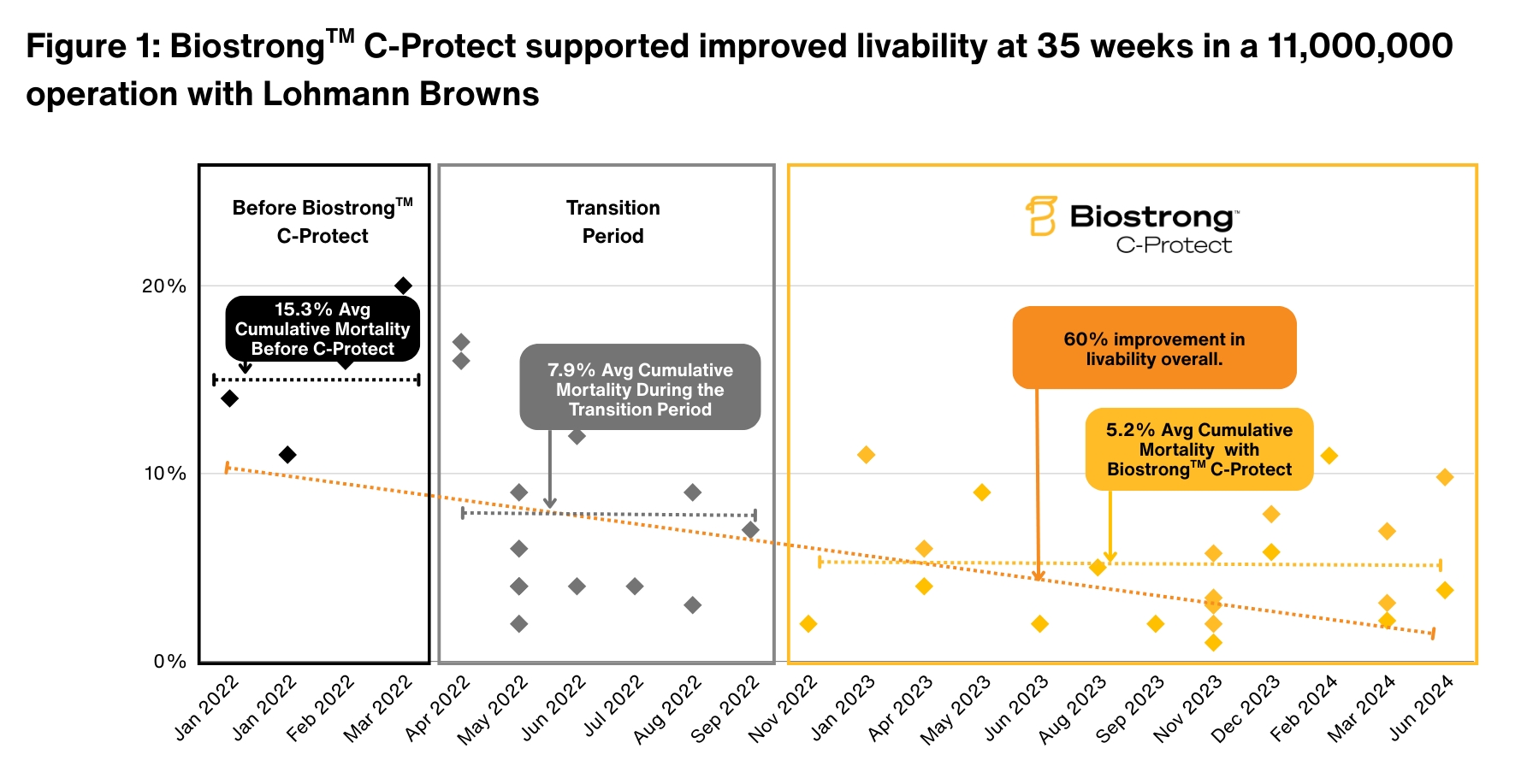
The product was introduced gradually as pullets reached the appropriate implementation age. Before adoption, average mortality rates at 35 weeks were 15.3%. During progressive adoption, mortality decreased to 7.9%, and once the product was fully implemented across operations, the rate dropped further to 5.2% at the same age. Overall, this represents a more than 60% improvement in livability (Figure 1).
Click to enlarge.
Validated approach
Biostrong C-Protect combines the postbiotic XPC™, a fermented yeast derivative shown to support immunity1, with a proprietary phytogenic blend derived from Quillaja saponaria that supports gut health and nutrient digestibility.2
According to Farmer, Cargill’s research team validated the product’s ability to target APEC in the laboratory prior to field testing.
“Feed additives are often trialed blindly, but we took a benchtop approach to understanding how the mechanisms of various products could complement each other and affect APEC and host resilience,” he said.
“This approach has helped us achieve the robust results we’re seeing in commercial settings.”
‘Robust, science-based outcomes’
According to Manuel Da Costa, DVM, PhD, director of strategy, marketing and technology for poultry at Cargill, the mortality reductions observed in this account are consistent with findings from controlled studies, which have also demonstrated improvements in egg production and gut health in APEC-challenged hens.2-4
“The ability to replicate outcomes from controlled studies in real-world operations is crucial to making informed decisions about flock health strategies,” Da Costa said. “We have trialed Biostrong C-Protect with APEC-challenge exposures at different bird ages, from 8-week-old pullets to 80-week-old layers, and the consistency of results is remarkable. The fact that field experiences mirror our research data should give layer producers confidence that they’re implementing a solution with robust, science-based outcomes.”
1 Lin et al, 2023. Effects of Saccharomyces cerevisiae hydrolysate on growth performance, immunity function, and intestinal health in broilers. Poultry Science, 102(1), 102237.
2 Chaney et al, 2024. Impact of BiostrongTM C-Protect, with or without vaccination, on broilers challenged with APEC serotype O78. Journal of Applied Poultry Research.
3 Hofacre et al., 2025. Effect of BiostrongTM C-Protect on Amelioration of APEC O78 in a 10 Week Layer Pullet Intratracheal Challenge Model. IPSF 2025.
4 Ko et al., 2025. Effects of BiostrongTM C-Protect on laying hens challenged with Avian Pathogenic E. coli. IPSF 2025.