



By Douglas L. Fulnechek, DVM
Senior Public Health Veterinarian
GTS Health
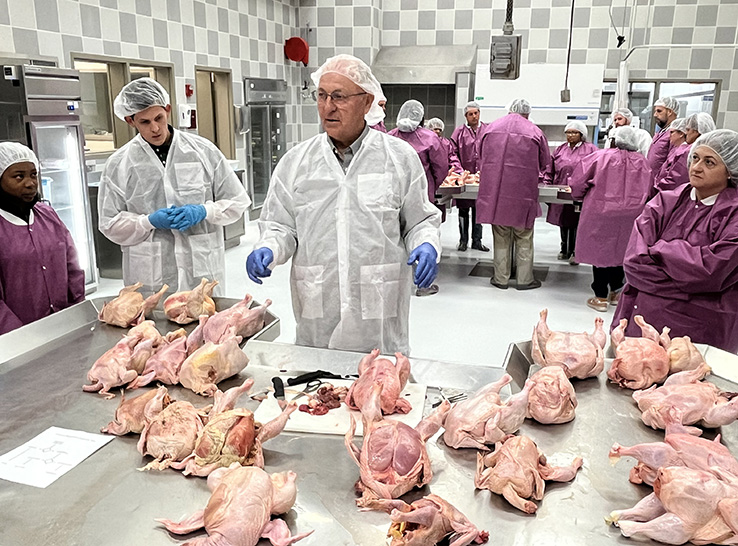
Every evisceration line assumes the birds are the same size. The venting, opening, drawing, cropping and neck-breaking machines fit the average bird. When a flock holds tight to that average, the equipment does what it was designed to do. When the flock uniformity spreads out, however, the machinery starts cutting in the wrong place, mutilating the carcass and sometimes spilling digestive tract contents.
That spillage is a problem because digestive tract content carries Salmonella and Campylobacter. Preventing that contamination is the heart of the government’s sanitary dressing requirement. Thus, a flock that shows up at the plant with too much size variation makes it difficult to meet that requirement.
Measuring the spread
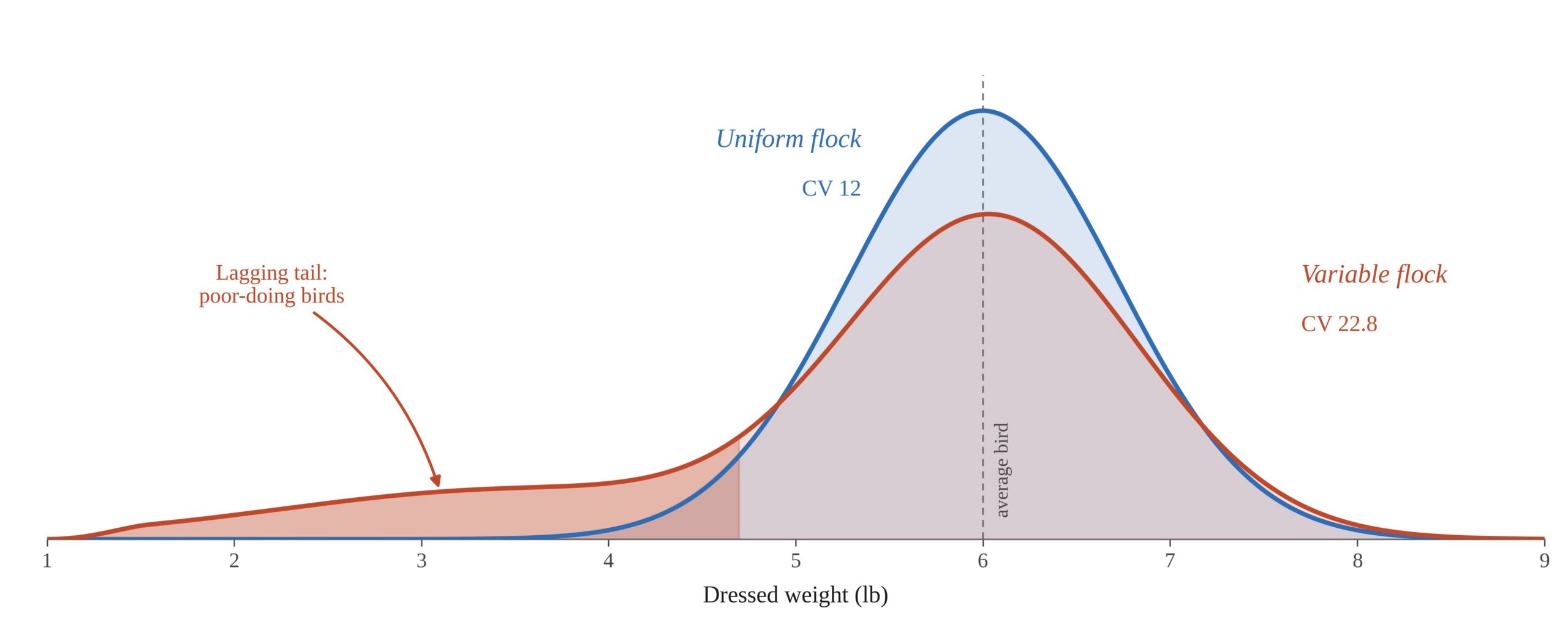
Flock uniformity is measured with the coefficient of variation (CV). It is a unitless number, often reported as a percentage. A CV of zero would describe a flock with no variation, perfect uniformity that nobody ever sees. A healthy straight-run 6-pound flock should have a CV of about 12. The number climbs as uniformity gets worse. I’ve measured flocks below 10, but those were sexed flocks. I’ve also measured flocks in the low teens that ran clean and flocks above 16 that gave the evisceration crew fits.
One useful aspect of the CV is that the weight data is easy to obtain at the plant. In some operations, quality assurance already collects it. I recommend calculating a CV on every flock. It turns the processing plant into a diagnostic window looking back at the farm.
What variation costs at the line
A non-uniform flock forces a compromise with the evisceration equipment. Set it for the big birds and the small ones get missed. Set it for the small birds and the large ones get cut and mutilated. Contamination increases, as does the load on the downstream antimicrobial interventions.
Under the New Poultry Inspection System, establishment sorters identify abnormal carcasses. An inconsistent-sized flock makes that call harder. Sorters usually condemn runts rather than risk a federal inspector stopping the line for failure to sort.
However, condemning a small but wholesome carcass or stopping an evisceration line is expensive. For a complex running 1.3 million birds a week, a whole-bird condemnation rate of 0.2% unsupportable condemnations costs approximately $500,000 per year. A stopped evisceration line costs about $800 a minute.
Variation starts on the farm
A flock’s uniformity at the plant is a record of every stressor, management slip and disease challenge. Non-uniformity is a symptom pointing to opportunities on the live side.
I once measured a CV of 22.8 in a flock. The chicks in one section of the transport vehicle got hot on the way to the farm. Birds weighed 1 to 8 pounds, with an average weight of 6 pounds. Roughly 20% of the flock was affected. It’s the best example I’ve seen of a flock that could not be processed in a sanitary manner.
Several factors contribute to flock variation. For example, chicks from different-age breeder flocks create a uniformity problem. Also, males grow faster than females, which explains why a straight-run flock has a higher CV than a single-sex house.
Culling failure is a common source of flock variation. Additionally, immunosuppressive diseases such as infectious bursal disease, Marek’s, chicken infectious anemia and adenovirus cause a non-uniform flock. So does reovirus arthritis, femoral head necrosis, retained yolk and any gut insult.
Researchers report that gut health is an important factor.1 Charles Hofacre, DVM, PhD, MAM, DACPV, has made the gut connection clear in his research.2 Coccidia-damaged intestines will make the flock have a high CV. In a bad necrotic enteritis outbreak, the surviving poor doers push up the CV. Instead of one clean upright curve, you get a lagging tail.
The same intestinal damage also allows Salmonella to colonize internal organs. Poor gut health simultaneously widens the curve and raises the pathogen load. That’s two problems with one root cause.
Closing the loop
Fixing uniformity requires the plant and live operations to talk to each other. Report the CV on every flock. Set a limit. When a flock is above the limit, treat it as a signal to investigate: pull the health records, check the hatchery, look at which breeder flocks fed those chicks and assign a cause before the next placement.
Most of what drives a bad CV is preventable, but someone on the live side must act on the numbers. The plant can’t fix a flock after it arrives. Having the plant report uniformity for every flock is how you improve. Uniformity is an indicator for bird health, welfare, yield and food safety. You must measure it to fix it.
Editor’s note: The views expressed in this article are solely those of the author.
References
- Choi J, Goo D, Ko H, Lee J, Kim WK. Factors Affecting Flock Uniformity in Broiler Production: Individual, Environmental, and Management Characteristics. Animals. 2026;16(2):185. https://doi.org/10.3390/ani16020185
- Hofacre C. “Gut Integrity’s Impact on Bird Health and Food Safety” (presentation, Virtual Poultry Tech Summit, October 20, 2020), as reported in Austin Alonzo, “How Intestinal Damage Causes Disease and How to Avoid It,” com, November 18, 2020. https://www.wattagnet.com/broilers-turkeys/article/15532288/how-intestinal-damage-causes-disease-and-how-to-avoid-it.