




Does providing welfare enrichments, which stimulate bird activity, affect feed-conversion ratio (FCR) in broiler chickens?
Because activity stimulates birds to eat more, and feed is the largest single cost in broiler production, questions have been raised about how these enrichments may affect production efficiency, such as FCR, which in turn may limit the adoption of welfare improvements.
However, an increasing number of studies show that some enrichments result in more movement and improved welfare without causing any detrimental effect on productivity. That said, most of those studies have been carried out in small-scale pen trials and not in commercial broiler flocks, where the real effects on FCR may be quite different.
Study design
Researchers at the University of Oxford monitored activity in commercial broiler flocks and related it to FCR and mortality. They described their findings in a recent edition of Poultry Science.
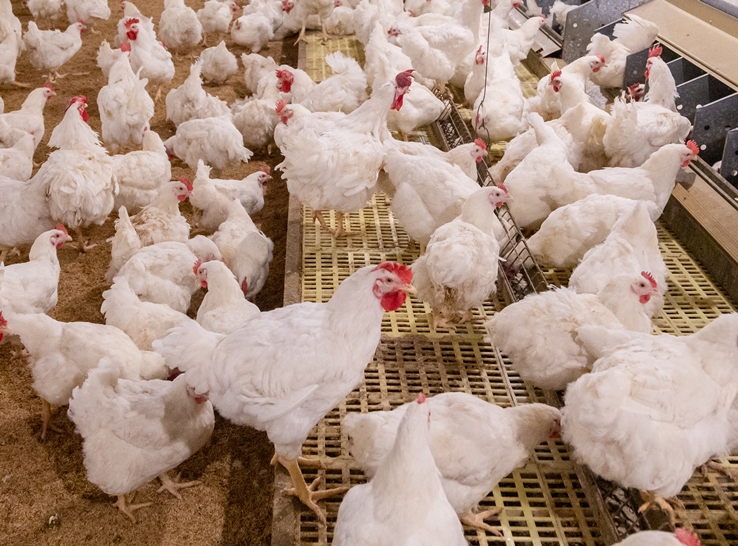
The researchers collected data from a commercial broiler farm in the southeastern US, studying 34 commercial broiler flocks over 12 cycles between December 2020 and November 2023. During the study, farm management made several changes, including varying the lighting and the number of enrichments — triangular huts — in various combinations (The research team had no control over these changes.).
To measure flock activity, the researchers used ceiling-mounted cameras positioned to capture bird behavior between the feeder and drinker lines. Image processing estimated optical flow velocities, which measure a flock’s average activity level.
Results
The 34 flocks showed a wide variation in both mortality and FCR. There was also variation in lifetime activity levels.
The results showed that FCR was no higher in more-active flocks and that, on average, more-active flocks tended to have lower (i.e., more efficient) FCR. There were also positive correlations between optical flow and mortality, as well as an even higher correlation between FCR and mortality, suggesting that the favorable effect of activity on FCR may, at least in part, be due to decreased mortality.
The researchers noted that their results directly address farmers’ concerns that improvements in broiler chicken welfare make birds more active and inevitably lead to a loss of efficiency. Further, a strong predictor of a high FCR was a greater number of birds within a flock being inactive.
Noting that the health and life expectancy benefits of exercise are well established in humans, the researchers reported that in broiler chickens being active also improves bone strength, decreases the incidence and severity of woody breast, and reduces the incidence of leg deformities and walking difficulties. Inactivity also causes birds to spend more time sitting in contact with litter, leading to a greater incidence of skin lesions, including contact dermatitis.
The research team pointed out that their results do not show that increasing activity will always improve FCR, but that under some circumstances, increased flock activity can be associated with increased efficiency.
Also, this study was limited to one farm and one broiler genotype. More studies in commercial settings are needed to understand which welfare enrichments have the greatest overall benefit.
What does this mean for producers?
- Bird activity may have a favorable effect on FCR, possibly via decreased
- Broiler activity may also have benefits to flock health, such as better bone strength, reduced incidence of wooden breast and fewer leg abnormalities.
The full paper, “Increased activity in broiler chickens is associated with better feed conversion,” can be found in Poultry Science and online here.
Editor’s note: Content on Modern Poultry’s Industry Insights pages is provided and/or commissioned by our sponsors, who assume full responsibility for its accuracy and compliance.