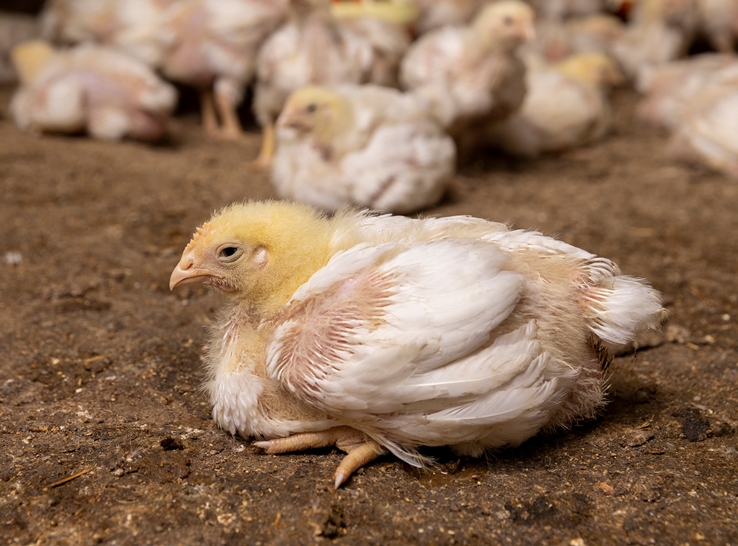





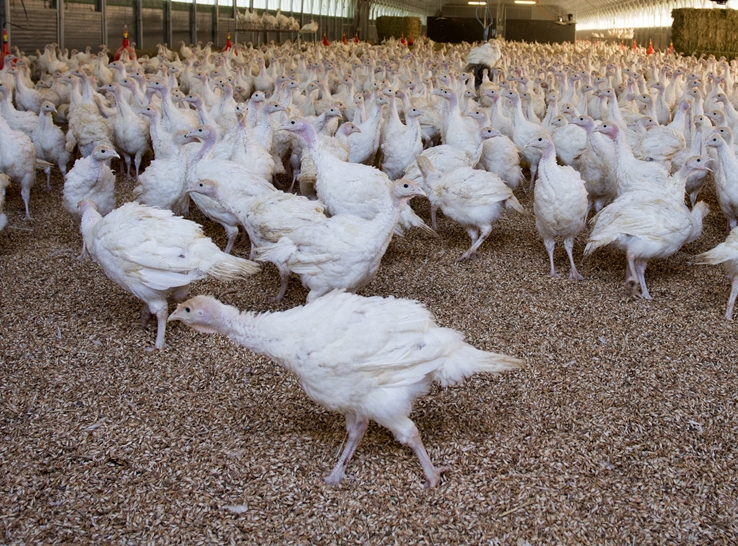
Raised to maximize meat production, commercial turkey toms are bred to grow quickly and gain weight in a short time. This begs the question whether the bird’s skeletal system meets that developmental challenge. Even though lameness is observed in less than 3% of US turkey tom flocks, its causes and severity occur in late production, when the producer has invested significant dollars, care and facility time in the birds. Of course, lameness is also a worthy welfare concern.
Stephanie Kulbacki, a poultry science graduate student at the University of Georgia, investigated skeletal, weight and age factors that might impact turkey lameness. She presented her research during the 2025 Poultry Extension Collaborative webinar on poultry welfare.
“Overall, we observed that commercial turkey toms’ bodyweight increases more quickly than their skeletal systems grow,” she noted. “Also, we concluded that a heavier bird does not mean stronger bones; conversely, a lighter bird does not mean weaker bones.”
Assess the gait
Conducting gait assessments within a turkey flock is a good place to start. “There are many causes of lameness — pathogenic, developmental, environmental and nutritional,” Kulbacki pointed out, “but genetics can also produce a predisposition. Thus, lameness is worth considering at the breeding flock level.”
One method to address this is to implement gait-scoring assessments. This can be done subjectively by categorizing a bird’s walking ability using a system such as the Bristol scale, in which zero is normal and 5 is severe lameness. “This scale is commonly used, efficient and effective, but human error and bias are possible,” she added.
There are also objective methods that use technical tools such as cameras and accelerometers to quantify the bird’s gait parameters.
“Scoring lameness is a good practice for both welfare and economic reasons,” Kulbacki said.
The experimental design
Kulbacki conducted two replicates (E1 and E2) while attending Purdue University to focus on environmental enrichments and their impact on skeletal quality and age effects. E2 also involved a sub-project to quantify gait parameters using a pressure-sensitive walkway.
At week 1, she assigned 400 male turkey poults to E1 and E2. At week 5, the birds received environmental enrichment, which included a platform with ramps at each end, a pecking block, a straw bale, a tunnel or a robot that used bright lights and sounds to move birds every other day. There was also a control group.
The first replicate occurred at week 8, with E1 looking at load-bearing bones: the femur and tibia. E2 involved addressing the right tibia and humerus and collecting plasma for bone-marker analysis.
Week 12 was the second sampling point for E1, during which bone morphological and biomechanical properties were analyzed. Kulbacki measured each bird’s weight, length, anterior-posterior diameter (averaged together), medio-lateral diameter and average bone diameter.
To quantify biomechanical properties, Kulbacki conducted a three-point bend test to identify the peak force and energy needed to fracture the bone. “Once the bone begins to fracture, the machine sends the information to a computer, recording a strength-test curve that we use to measure different biomechanical properties,” she said.
At week 16, Kulbacki collected two birds from each pen for a total of 48 birds, with each given a gait score of 0 (normal) or 1 (lameness). The birds also made four passes on a pressure-sensitive walkway, which were reviewed manually. “The pressure test showed right and left leg movements and the amount of pressure,” Kulbacki noted. All birds were weighed before the test.
The birds were euthanized on week 17, with Kulbacki removing the right tibia and humerus and collecting plasma for further assessment.
On week 18, samples were collected from the remaining E1 birds to analyze bone morphological and bone biomechanical properties.
Objective 1: Age and enrichment effects
Kulbacki first assessed any age-related changes and effects of environmental enrichment on bone properties in the turkey toms.
The enrichment results were mixed. At 8 weeks of age, the tunnel had a larger effect than the platform on bone diameter and femur and humerus weight. “We did see an improvement in biomechanical properties’ difference at 8 weeks of age for the tibia with the pecking block and the straw,” she said.
Whether the birds used the enrichments is still being reviewed, but observing that the birds used the straw bale and the tunnel was positive, Kulbacki added.
As for bodyweight effects, more growth typically occurs from 8 to 12 weeks of age (174.3%) than from 12 to 18 weeks (104.48%). “But the birds are still growing substantially in the later weeks,” she emphasized.
Due to time constraints, Kulbacki reported only the percentage growth results for the tibia during the webinar. Here is a summary of age effects for the tibia:
| 8-12 weeks | 12-18 weeks | |
| Bone length | 34.66% | 8.66% |
| Bone diameter | 44.74% | 13.96% |
| Bone weight | 110.84% | 18.79% |
| Peak force | 43.41% | 29.62% |
“There was a drastic difference in bone weight,” she pointed out. “We also looked at the relationship between bodyweight and bone parameters and the peak force/bodyweight correlation for the tibia.”
That broke out as follows: at 8 weeks, moderate correlation; 12 weeks, 30% correlation; 18 weeks, negative correlation. “So, the correlation declined as birds aged.”
Understanding that heavier birds do not equate to stronger bones, Kulbacki and the team sorted bodyweights into low, medium and high groups at 8, 12 and 18 weeks.
They found no difference in the peak force at 8 weeks. But at 12 weeks, the heaviest weight group had higher bone density than the medium group. However, the difference completely disappeared by the time birds reached 18 weeks.
Kulbacki summarized that enrichments had limited and inconsistent effects on skeletal properties across ages. Significant bone growth occurs in the earlier production phase (8 to 12 weeks). The correlation between bodyweight and skeletal traits declined sharply as the birds aged.
Objective #2: Legs and gait
For the second objective, Kulbacki used three parameters — cadence, gait time and velocity — to evaluate any restrictions. “We saw that gait score 1 (GS1) birds took fewer steps per minute, took a longer time and moved at a slower speed than gait score 0 (GS0) birds,” she noted.
She also evaluated the left and right legs to determine if there were gait differences. “We compared GS0 to GS1 right legs, and the same for the left legs,” Kulbacki said. “Then we looked at differences between the right and left legs.”
GS0 birds had a longer stride than GS1 birds, and GS1 birds took a longer time to take a long step.
As for maximum force and feet pressure, or the weight-bearing load a bird placed on a leg, GS1 birds put on more pressure compared to GS0 birds.
“We saw a greater difference in the right leg versus the left for GS1 than GS0, which showed the GS1 birds relied a bit more on the right leg compared to GS0 birds,” she noted. “Overall, it appeared that the left legs had more restriction.”
For this segment, Kulbacki concluded that gait score did not influence bodyweight. Parameters such as cadence, gait velocity and gait time differed between gait scores. The left leg of impaired birds had longer step lengths and higher maximum forces than those of unimpaired birds. The gait score did not affect the right tibia or humerus.
In conclusion
Overall, Kulbacki observed that bodyweight in commercial turkey toms increases more quickly than their skeletal systems grow.
Environmental enrichments had minimal effect on bone quality, but she said this merits further study.
“One big thing,” Kulbacki noted, “is that there’s potential to apply skeletal parameters to turkey breeding without sacrificing current bodyweights in commercial birds.”
Finally, the team determined that an objective pressure-sensitive walkway supported a subjective gait-scoring method.