
Reading the hens’ behavior: What activity and play tell us about welfare in cage-free aviaries

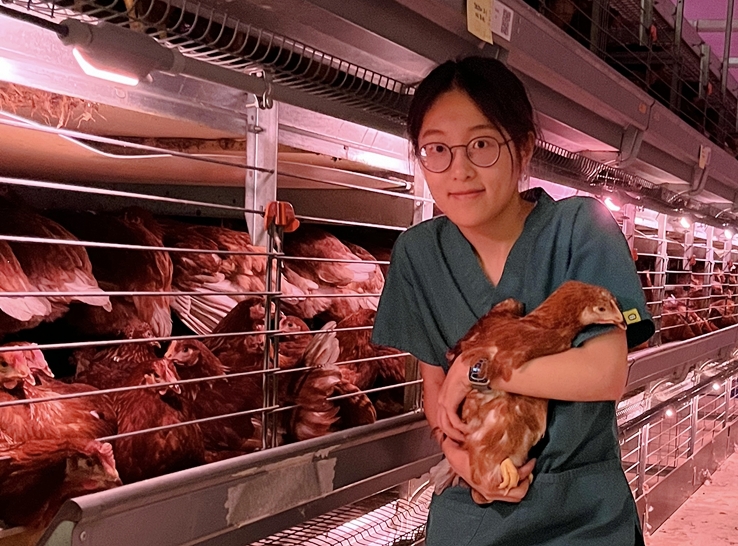
A “Rising Stars” article
by Xiaowen Ma, MS
Department of Animal Science
Michigan State University


A “Rising Stars” article
by Xiaowen Ma, MS
Department of Animal Science
Michigan State University
Salmonella exposure to consumers from eggs has been a decades-long concern. Richard Gast, poultry research microbiologist at USDA’s US National Poultry Research Center in Athens, Georgia, has developed two research projects to gain more perspective on Salmonella Enteritidis in cage-free layer housing.
While some mortality is expected in all layer flocks, regardless of the housing type or breed, the rate and causes can vary depending on the production system. Cage-free systems may not inherently have higher mortality than cages and experience in managing birds in cage-free systems plays a big role in maintaining low mortality.
The move to cage-free egg production has spawned a new generation of aviary systems available for hen housing. The question now is how well the new systems perform when balancing egg production and profitability with bird welfare.
Change is constant and there’s always a learning curve. Such was the case around 2017, as pressure built toward more cage-free housing systems for egg-laying hens along with the push to reduce antibiotics or antibiotic substances in animal diets.