
Reading the hens’ behavior: What activity and play tell us about welfare in cage-free aviaries

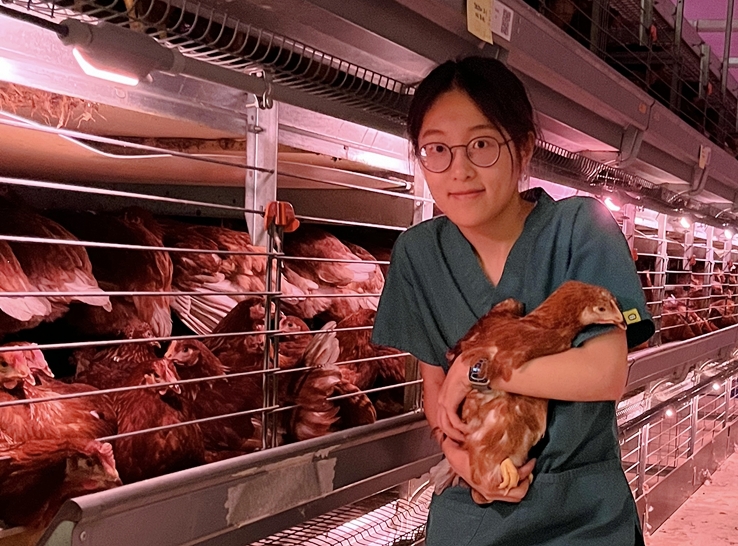
A “Rising Stars” article
by Xiaowen Ma, MS
Department of Animal Science
Michigan State University


A “Rising Stars” article
by Xiaowen Ma, MS
Department of Animal Science
Michigan State University
Salmonella exposure to consumers from eggs has been a decades-long concern. Richard Gast, poultry research microbiologist at USDA’s US National Poultry Research Center in Athens, Georgia, has developed two research projects to gain more perspective on Salmonella Enteritidis in cage-free layer housing.
The shift to cage-free layer housing opened the door to poultry diseases that disappeared during the years of cage housing. At the Devenish Symposium held during the 2025 PEAK conference, Dan Wilson, DVM, Wilson Vet Co., discussed the return of several diseases from the past that affect today’s egg layers.
By Alexander W. Strauch, DVM
Poultry Veterinarian
Four Star Veterinary Service, LLC
Minton Veterinary Service Office
Chickasaw, Ohio, USA
The recent shift to cage-free production has led to more problems with internal parasites and coccidiosis, explains Kenneth Anderson, MS, PhD, North Carolina State University, in a Q&A sponsored by Cargill Animal Health.
The first comprehensive literature review in 40 years presents up-to-date research and best practices to prevent floor egg laying.
Breeding birds for efficient cage-free production requires developing healthy hens that lay an egg every day for 100 weeks and possibly up to 200 weeks in the future, reported Sijne Van der Beek, PhD, chief technology officer, Lohmann Breeders, The Netherlands.