





By Ken Opengart, DVM, PhD, DACPV
3 Birds Consulting
Signal Mountain, Tennessee
The Five Domains provides an actionable framework to better assess and communicate about the dynamic continuum of animal welfare. A quick review of the Five Domains can be found in my article published earlier this year in Modern Poultry and is also illustrated in the graphic below (Figure 1).

Figure 1
As a reminder, the Five Domains framework offers a practical and understandable approach to explaining how various parameters and their outcomes impact the overall mental state and welfare of the animals entrusted to our care. In other words, it better connects what an animal experiences to the welfare outcomes that are produced.
Because the Five Domains references the mental state, it reinforces that the affective state of the animals with which we work, or what the animal experiences, is important. This moves us from managing welfare compromise and providing our animals with a “life worth living,” which implies minimal suffering, to providing them with a “good life” in which positive experiences are promoted.
Within each of the four physical or functional domains, the animal may experience favorable or unfavorable outcomes; the totality of these experiences determines whether the animal’s overall mental state is favorable or unfavorable. If the overall mental state is favorable, we can say that the animal’s welfare is good. If the overall mental state is compromised, there is an opportunity to enhance the animal’s welfare.
Practically measuring mental state, however, is difficult within the environments in which we operate. In fact, with the knowledge and experience we have today, operationalizing the Five Domains and using this framework as an assessment tool in a production environment is difficult, if not impossible.1
Using key welfare indicators
It is important to remember, however, that we can measure outcomes relative to the physical or functional domains using key welfare indicators (KWIs), which are objective, outcome-based observations that can be measured, monitored and managed to assess welfare.
For KWIs to be most effective, they must be repeatable, reliable and practical to implement. KWIs also need to be actionable, meaning we want there to be something we can act on and change in what the animal experiences that will lead to a more favorable welfare outcome. This is how we drive continuous improvement.
Where KWIs meet our expectations, we can show compliance. Where we identify opportunities for improvement in welfare, we can develop action plans to address these opportunities and demonstrate commitment to continuous improvement in welfare outcomes. In this way, we can use these indicators to communicate about progress in welfare outcomes over time. For a comprehensive review of poultry KWIs, please review the International Poultry Welfare Alliance’s KWI Guides for layers, turkeys and broilers (Figure 2).
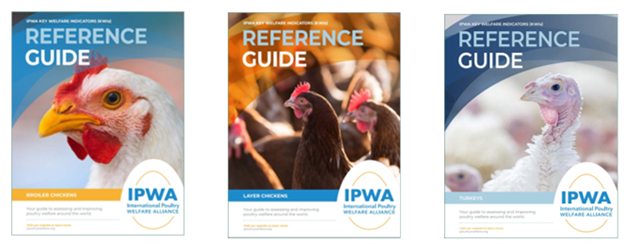
Figure 2
With this in mind, we can use KWIs as proxies for what the birds are experiencing, relative to the functional or physical domains, as we assess their welfare. Identifying those factors that contribute to an unfavorable mental state allows us to take actions that will lead to more favorable outcomes and, ultimately, a higher welfare state for the animal. We can use observation of the animal in its environment or other outcomes, such as environmental metrics, to identify areas for improvement and, more intentionally, make the connection between specific conditions and welfare outcomes, so that opportunities can be more quickly identified and addressed. Using KWIs within the context of the Five Domains framework also helps ensure birds receive proper nutrition, comfort, health care and appropriate behavioral opportunities, which together foster positive mental states and overall welfare outcomes.
Real-world example with KWIs, Five Domains
Let’s work through an assessment of a house of 5-day-old chicks or poults using KWIs and the Five Domains framework. Here’s the situation: You’ve just entered a poultry house and noticed that the birds are packed under the brooders and in the feed pans. You see that the birds are lying down, huddling together and not moving much. Upon further examination, you notice by looking at their legs that they are dehydrated and that they haven’t eaten because their crops are empty. They don’t show any signs of clinical disease or other chick/poult quality issues, and you deduce they are chilled.
Let’s walk through a few questions to make an assessment using KWIs and the Five Domains.
Q: What are some KWIs you could use to assess the welfare state of this house of birds?
A: One way to assess the welfare impact of this situation is by observing KWIs that are currently impacted, such as body condition (dehydration, empty crops) and behavioral interaction (huddling, lethargy and vocalization). We also need to recognize that welfare compromise in this young flock may also negatively impact KWIs that appear as the birds grow older, i.e., cull percentage, 7-day mortality, total mortality and flock condition (average daily gain, uniformity).
Q: Which of the four physical domains would have been impacted based on your observations? Given what you observed when you assessed the KWIs, how would you describe what the chicks experience and what would be the overall impact on the mental state?
A: All four physical domains are impacted in this situation. The sub-optimal environment is the primary driver for the young birds acting the way they are. Their behavioral interactions are altered in that they’re not spreading out across the house; their nutrition is negatively impacted because they’re not eating or drinking and they’re not performing their normal social behaviors. Their overall health will be compromised without feed, water and heat. Consequently, the birds would experience weakness, cold, hunger, and thirst and their mental state would be negatively impacted.
Q: An important aspect of identifying what is abnormal is understanding what normal looks like. How might the behavioral interactions of these birds differ from those of birds in an optimal environment?
A: Young chicks or poults in an environment that is providing the proper amount of heat will naturally explore their environment, evenly disperse themselves throughout the house and look for feed and water. Birds that are chilled, however, are interested in conserving their body heat and will huddle and/or pile and will be reluctant to move away from the heat they’re generating.
Q: Understanding the Five Domains framework helps us identify opportunities for improvement. The opportunity here is to improve the environment. What changes might the grower make to improve the situation within the house, which would, ultimately, improve the birds’ welfare?
A: You provide guidance to the grower to change the ventilation program by increasing the ambient temperature in the house, while ensuring that the ventilation is adjusted so that air quality remains good. After several minutes, the birds begin to spread out across the house.
Q: After the birds have had a period to acclimate to the change in the environment, how would the KWIs that were evaluated the day of this visit change?
A: As the birds warm, they will begin to huddle less, spread out throughout the house, explore their environment, socialize with each other, have more normal vocalization (less vocalization associated with stress) and eat and drink. In the hours after the birds begin to eat and drink, they will begin to rehydrate and fill their crops with feed. KWIs associated with body condition (hydration status, crop fill) and behavioral interaction (activity, vocalization) will return to that of a well-adjusted and well-cared-for house of birds.
Q: Which of the four physical domains would be impacted by the management changes? What would you predict the mental state of the chicks or poults to be at this point?
A: Warming up the poultry house and adjusting the ventilation promotes more positive and desired welfare outcomes in the four physical domains. Because the domains have moved from unfavorable to more favorable outcomes and, as a result, the birds experience satiety, thirst quenching, thermal comfort, and more normal behavioral interactions with their environment and their flock mates, we can therefore say that the mental state and welfare of the flock have improved.
Q: The Five Domains is a practical and actionable framework that can be used to educate individuals about opportunities to mitigate negative outcomes and promote positive outcomes. How might the behavioral interactions of those managing these birds be different than those growing a flock that wasn’t compromised, and what was the educational opportunity presented?
A: The opportunity here was that the growers on this farm may not be as observant as those who are managing a “normal” flock. They may have missed the observations that would have indicated their birds were in a negative welfare state and, in this way, missed the opportunity to move them to a more positive welfare state. By explaining how the physical environment negatively impacts the four domains and, ultimately, the fifth domain, we hope to increase growers’ awareness and understanding of how their actions affect welfare and performance.
It’s important to remember that an animal’s welfare is a continuum that depends on what an animal experiences and how those experiences impact its physical and affective states. KWIs are critical metrics we can use to identify opportunities for improvement in welfare, develop action plans to address areas of welfare compromise and drive continuous improvement. If we improve the KWIs, we are improving welfare outcomes. If we are improving the welfare outcomes, we are moving the animals to a more favorable welfare state.
With awareness of the Five Domains and how that defines an animal’s experience, plus the understanding that we can use KWIs to measure, monitor and manage welfare outcomes, we can forge a stronger connection between our individual roles and responsibilities and our ability, as stewards of animals, to positively enhance their life experience and better communicate about our commitment to animal welfare within the poultry value chain.2
References
- Hampton JO, et al. Rethinking the utility of the Five Domains model. Anim Welf. 2023 DOI: 1017/awf.2023.84.
- Beausoleil N, et al. Application of the Five Domains model to food chain management of animal welfare: opportunities and constraints. Frontiers Anim Sci. 2023. DOI: https://doi.org/10.3389/fanim.2023.1042733.
Editor’s note: The views expressed in this article are solely those of the author.