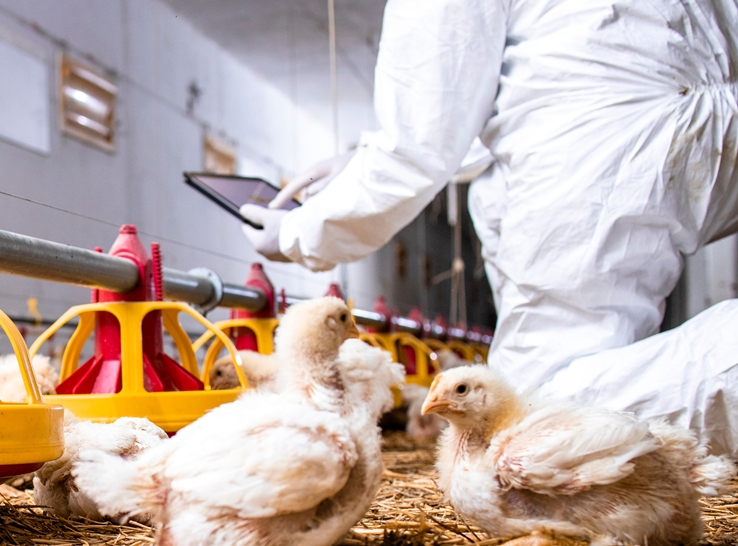





In December 2025, US Poultry & Egg Association (USPOULTRY) released an updated report quantifying the US poultry industry’s on-farm antibiotic use.
The report reflects the poultry industry’s continued efforts to improve antibiotic stewardship and its commitment to disease prevention within poultry production. As part of its commitment to a transparent and sustainable food supply, the industry aims to balance the responsible use of antibiotics considered “medically important” to human health with the need to keep flocks healthy.
Key findings for each sector:
Broilers
The report noted several key changes in antibiotic usage in broiler chickens from 2013 to 2024:
- Broiler chickens receiving antibiotics in the hatchery decreased from 90% in 2013 to less than 1% in 2024.
- Medically important in-feed antibiotic use in broiler chickens decreased substantially. There has been no in-feed tetracycline use since 2019, and virginiamycin use has decreased more than 99% over the 12-year period.
- Medically important water-soluble antibiotic use in broiler chickens decreased substantially from 2013 to 2017 and has increased slightly from 2017 to 2024. Increases were typically due to increased disease incidence, as seen in other countries as well, from 2019 to 2024.For example, avian metapneumovirus has caused severe morbidity and mortality in some broiler flocks. Infection with this virus can increase the incidence of secondary bacterial infections. Tetracycline antimicrobials have been used to treat and control these secondary infections but with limited efficacy.
-
- Penicillin use decreased by 64% from 2013-2019 but has increased 27% from 2019 to 2024 due to increases in gangrenous dermatitis incidence. Overall, penicillin use decreased 53% from 2013 to 2024.
- Lincomycin use decreased by 66% from 2013 to 2020 but has increased 15% from 2020-2024 due to increases in gangrenous dermatitis incidence. Overall, lincomycin use decreased 71% from 2013 to 2024.
- Tetracycline use decreased by 66% since 2013.
- Sulfonamide use decreased by 81% since 2013.
Turkeys
The report also noted several key changes in antibiotic usage in turkeys from 2013 to 2024:
- Turkeys receiving antibiotics in the hatchery decreased from 97% in 2013 to approximately 45% in 2024.
- With recent challenges linked to Escherichia coli and other Gram-negative bacteria in the young turkey poults, gentamicin use in the hatchery increased to help prevent these infections.
- Hatchery gentamicin use decreased approximately 40% from 2013 to 2024.
- Medically important in-feed antibiotic use in turkeys decreased substantially. In-feed tetracycline use decreased by more than 77% from 2013 to 2022 but has increased more than threefold since 2022, predominantly due to the control and treatment of secondary bacterial infections following infection with avian metapneumovirus.
- Medically important water-soluble antibiotic use in turkeys decreased substantially from 2013 to 2019 and then stabilized or increased from 2019 to 2024. Increases were typically due to increased disease incidence, as seen in other countries as well, from 2019 to 2024.Avian metapneumovirus has caused severe morbidity and mortality in turkey flocks. Infection with this virus can increase the incidence of secondary bacterial infections. Water-soluble tetracycline antimicrobials have been used to treat and control these secondary infections but with limited efficacy:
-
- Penicillin use decreased by almost 50% since 2013.
- Lincomycin use decreased by 58% from 2013 to 2019 but increased substantially from 2020 to 2024 due to increases in gangrenous dermatitis incidence and a penicillin shortage.
- Neomycin use decreased by 67% since 2013.
- Tetracycline use decreased 21% from 2013 to 2022 but increased from 2022 to 2024, largely due to increases in colibacillosis and secondary infections following avian metapneumovirus exposure.
Layers
Layers typically begin laying eggs around 20 weeks of age and end around 80 to 100 weeks of age.
Table-egg production is similar to milk production — the product for human consumption is produced daily. Most antibiotics that could be administered to layer hens have withdrawal periods that would prevent all eggs produced during this period from entering the food supply. This is one reason why there is little antibiotic usage in table-egg production in the US.
Below are the key findings for antibiotic usage in layers from 2016 to 2024:
- All chicks in the dataset received gentamicin in the hatchery (day 1 of age).
- In the US, most chicks purchased by egg companies are sourced from hatcheries that are owned and operated by genetics companies.
- The primary medically important antibiotic used in layer hens for treatment and control of disease in this dataset was chlortetracycline (CTC), used partly because it has a zero-day withdrawal when used in-feed, meaning there is no loss of eggs during the treatment period.
- CTC was only administered via the feed in pullets (day 2 through 16 to 18 weeks of age) and layers.
- More than 95% of CTC was used in the layers to treat disease. No pullets in the dataset were given CTC in the feed during 2022 or 2023, and a minimal amount was used in pullets in 2024.
- Less than 0.1% of total hen-days were exposed to CTC.
Report history
This report represents a 12-year set of data collected from 2013 to 2024 for US broiler chickens and turkeys and a 9-year set of data collected from 2016 to 2024 for layers.
Randall Singer, DVM, PhD, MPVM, founder of Mindwalk Consulting Group, LLC and professor of epidemiology at the University of Minnesota, directed the research for the report with funding from USPOULTRY and the US Food and Drug Administration – Center for Veterinary Medicine.
In December 2024, USPOULTRY released a report, whose research was also directed by Singer, covering antibiotic use in poultry from 2013 to 2023. In 2023, Singer published three peer-reviewed manuscripts that covered data collected for that report from broiler chickens, turkeys and layers.
“This research highlights the industry’s sustained commitment to science-based stewardship and the responsible use of antibiotics in poultry production,” said Nath Morris, USPOULTRY president.
According to USPOULTRY, collecting data on antibiotic use in poultry will assist the poultry industry as it aims to improve antibiotic stewardship and document the burden of flock illness and reasons for on-farm, medically important antibiotic usage.
Given several key differences among broiler chickens, turkeys and layers — namely, differences in weight, life span, susceptibility to lifetime illness and the number of effective medical treatments available — USPOULTRY advised that these data should neither be combined nor compared between poultry types.
Additionally, “It is important to remember that these data are only part of the story regarding stewardship,” Singer said.
Study details can be found at https://mindwalkconsultinggroup.com/. The updated infographic report can be viewed here.
Editor’s note: Content on Modern Poultry’s Industry Insights pages is provided and/or commissioned by our sponsors, who assume full responsibility for its accuracy and compliance.