





As resistance continues to erode the effectiveness of traditional anticoccidial programs in turkeys, veterinarians are increasingly focused on strategies that protect birds while preserving available tools. A multi-year field experience with a US heavy tom producer suggests that coccidiosis vaccines can play a practical role in conventional rotation programs, supporting bird health and improving overall program stability.
According to Kelli Jones, DVM, poultry technical services veterinarian with Ceva Animal Health, the producer’s decision to integrate vaccination followed years of mounting resistance pressure.
“Most of these chemicals have been used in the industry for decades,” Jones said. “Over time, the organisms adapt. When you do see a failure, it tends to be abrupt — with lesions, clinical signs and significant performance loss.”
Fewer tools, more pressure on rotations
Historically, the producer relied on rotating chemical anticoccidials and ionophores to control coccidiosis. That approach became more challenging after the removal of nitarsone, which increased reliance on a smaller number of remaining products.
“Producers were cycling through what they had available, but the duration of effectiveness kept shrinking,” Jones said. “They were seeing more frequent breaks, and veterinarians didn’t have many alternatives to turn to.”
At the same time, the company had already adopted coccidiosis vaccination in its no-antibiotics-ever flocks, where ionophores were not permitted.
“In those flocks, vaccines weren’t optional — they were necessary,” Jones said. “That gave us a good understanding of how vaccine programs behave and what to expect from them.”
Incorporating vaccine into a conventional program
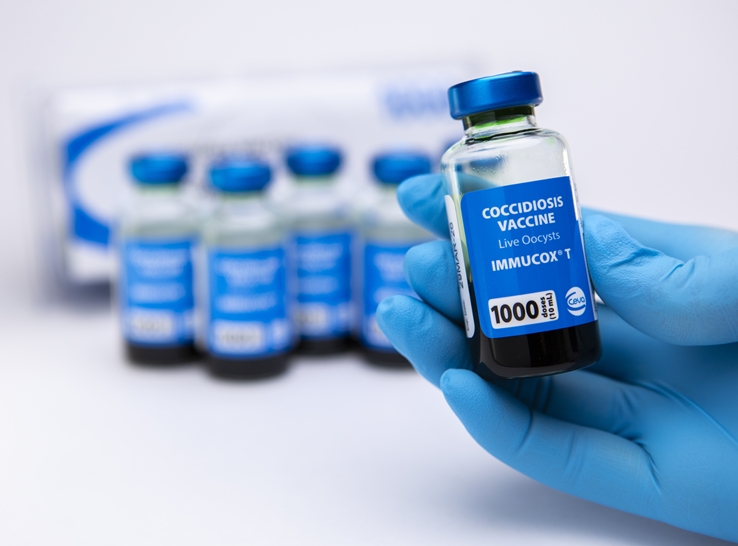
Beginning in 2018, the producer introduced Immucox T into its conventional turkey program on a seasonal basis. Birds were vaccinated at day of age using hatchery gel application and received feed without anticoccidials during the vaccine period.

Vaccine gel droplets
Vaccination was typically used from mid-January through mid-June, followed by a chemical anticoccidial and later an ionophore. During the vaccine window, use of amprolium — a therapeutic anticoccidial often used to suppress clinical outbreaks — was tightly restricted and administered only under veterinary oversight.
Bird health and intestinal status were monitored through weekly mortality tracking during the 3 to 8 week window, oocyst cycling assessments, quarterly necropsies and evaluation of trichomonads.
“With a vaccine program, you expect to see oocysts,” Jones said. “That’s part of how immunity develops. What you’re watching for is whether that cycling stays controlled.”
Performance comparable, rotations improved
Across multiple years, mortality and overall performance during the vaccine period were comparable to historical anticoccidial programs in heavy toms.
“What stood out was that vaccination protected birds in the long run just as effectively as the chemical-based programs producers we’re accustomed to using,” Jones said.
More notably, the producer observed that anticoccidial programs used after the vaccine phase performed better than in prior years.
“Vaccines give the system a reset,” Jones explained. “By restoring sensitive populations of coccidia in the barns, the products you rotate back to tend to work better.”
That benefit extended beyond the months when the vaccine was actively used.
“You might vaccinate for only part of the year,” she said, “but the months that follow can show very strong performance because you’ve reduced resistance pressure.”
Vaccination also reduced the risk of late-cycle coccidiosis breakdowns — a major concern in older, heavier birds.
“Those late breaks are expensive,” Jones said. “Avoiding them protects both bird health and overall flock economics.”
Gut health indicators support findings
In addition to traditional coccidiosis metrics, the producer tracked trichomonads, protozoal organisms commonly found in the turkey gut that can serve as a general indicator of intestinal health and stability.
“We use trichomonads as a barometer for gut health,” Jones said. “When the gut is stressed, you tend to see more of them.”
During years when vaccination was included in the rotation, trichomonad prevalence was lower, suggesting improved intestinal stability alongside coccidiosis control.
“Gut health in turkeys is always a balancing act,” Jones said. “Seeing fewer secondary issues tells you the program is more stable overall.”
Long-term immunity and compensatory gain
Jones emphasized that vaccines offer benefits that extend beyond immediate disease control, particularly in a species with a long grow-out period.
“Vaccines induce long-term immunity,” she said. “Birds go through that immune response early, and because turkeys live long enough, they have time for compensatory gain.”
Management determines success
Jones stressed that successful vaccination depends heavily on barn-level management, not just hatchery application.
“Roughly 80% of immunity development happens in the barn,” she said. “If things like litter moisture, temperature, air quality or bird density aren’t right, you can compromise that process.”
She also noted that some commonly used products have anticoccidial effects that may interfere with vaccine cycling.
“Even some antibiotics have anticoccidial properties that aren’t always obvious,” Jones said.
Her advice to veterinarians and producers considering vaccination as part of a rotation is straightforward.
“Let your supplier know you plan to use vaccination and reach out for technical support,” Jones said. “There’s a lot of nuance, but when it’s done correctly, it can be a very effective part of a long-term control strategy.”
Editor’s note: Content on Modern Poultry’s Industry Insights pages is provided and/or commissioned by our sponsors, who assume full responsibility for its accuracy and compliance.