





Newcastle disease (ND) is one of the most recognized viral diseases of poultry worldwide. In the US, however, the devastating outbreaks seen in other regions are rare.
So what does it mean when Newcastle disease virus (NDV) appears in diagnostic testing during respiratory disease investigations?
According to Mark Jackwood, PhD, and Jose Linares, DVM, of Ceva Animal Health, the answer often has less to do with Newcastle itself and more to do with the complex mix of pathogens affecting commercial flocks.
A global disease — but a different US reality
NDV infects nearly all avian species and is widely distributed around the world. The strains responsible for severe disease and high mortality — known as virulent ND viruses — are considered exotic to the US.
“The highly virulent strains that cause severe disease are treated as a foreign animal disease in the US,” Jackwood said. “If they are detected, they are eliminated through a stamping-out program.”
Because of aggressive control policies and widespread vaccination, virulent ND has remained largely absent from US commercial poultry production.
What diagnosticians are far more likely to encounter are low-virulence ND viruses.
“These viruses are genetically similar to strains used in many live ND vaccines,” Jackwood said. “By themselves, they typically do not cause significant disease.”
Why NDV sometimes appears in respiratory investigations
Even so, NDV occasionally appears in diagnostic testing when flocks are experiencing respiratory problems.
That can raise concerns initially because Newcastle is a reportable disease when virulent strains are involved, Linares noted — but sequencing usually provides important context.
“When those viruses are sequenced, they are usually identified as low-virulence viruses; in many cases, the sequences match or are very closely related to strains used in live ND vaccines,” he said.
“However, detecting NDV in these situations does not necessarily mean it is the primary cause of the respiratory signs.”
Part of a larger respiratory disease complex
While low-virulence ND viruses typically cause little or no disease on their own, Jackwood noted that they may contribute to the overall respiratory disease complex when other pathogens are present.
Respiratory pathogens such as avian metapneumovirus, infectious bronchitis virus, avian mycoplasmas and bacterial infections can interact within a respiratory disease complex and influence the overall clinical outcome, he explained.
Immunosuppressive agents may also play a role.
“If birds are dealing with something like infectious bursal disease virus, their immune response may be compromised,” Jackwood said. “That can make them more susceptible to other pathogens.”
In these situations, NDV may be detected alongside other pathogens even if it is not the primary driver of disease.
“Live ND vaccines can contribute to the disease complex, especially stronger vaccines like LaSota, when they are applied on top of an existing infection with other pathogens such as avian metapneumovirus,” Jackwood said. “This reinforces the importance of proper timing and flock health when implementing vaccination programs.”
Not an emerging problem
Newcastle disease itself does not appear to be an emerging problem in US poultry production, Linares said, noting that recent respiratory investigations in which NDV was detected were primarily driven by other pathogens — particularly avian metapneumovirus and bacterial co-infections — as well as seasonal respiratory disease pressures.
Still, the virus remains an important global disease, and the risk of introduction has not disappeared.
“Virulent ND viruses circulate in many parts of the world,” Linares noted. “They have been introduced into the US in the past, often through non-poultry bird species.”
For that reason, surveillance, vaccination and biosecurity remain important safeguards.
Vaccination remains essential
Vaccination continues to be the foundation of ND prevention in US poultry flocks.
“One important point is that NDV has only one serotype,” Jackwood said. “That means properly applied vaccines protect against disease even when different genetic variants of the virus are circulating.”
Live vaccines derived from low-virulence viruses are commonly used in broilers. Inactivated vaccines are typically used in layers and breeders to stimulate strong systemic immunity and transfer maternal antibodies to chicks. Recombinant vaccines using herpesvirus of turkeys as a vector are also widely used.
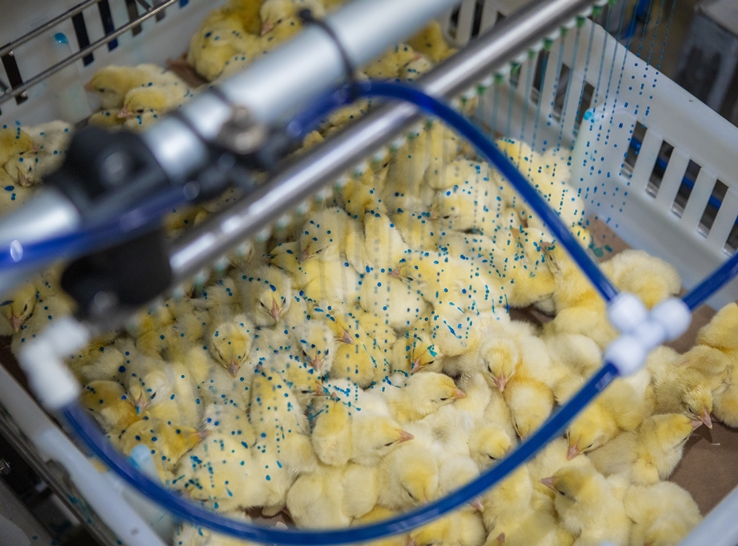
For vaccination programs to be effective, most birds in the flock must receive an adequate immunizing dose. Vaccine dose and timing are critical factors, since birds need sufficient exposure to the vaccine virus to develop protective immunity before they encounter field challenge. In practice, this means ensuring that vaccines are administered correctly and that coverage across the flock is high enough to establish strong population-level immunity.
“Research indicates that at least about 85% of birds need to receive an immunizing dose of vaccine to achieve good flock protection,” Jackwood said.
Building effective ND vaccination programs
In broilers, mild live vaccines are commonly administered early in life, often in the presence of maternal antibodies, whereas longer-lived birds such as layers and breeders typically receive inactivated vaccines to stimulate strong systemic immunity and transfer maternal antibodies to their offspring. Recombinant vector vaccines can also be used early in life and are designed to minimize respiratory reactions while providing protection.
According to Linares, maintaining optimal vaccination programs that lead to effective immunization helps ensure that, if virulent ND viruses were introduced into the US poultry industry, flocks would have some level of protection.
“The industry has done a good job keeping virulent ND out of commercial production,” he said. “Continued vigilance will be important to keep it that way.”
Editor’s note: Content on Modern Poultry’s Industry Insights pages is provided and/or commissioned by our sponsors, who assume full responsibility for its accuracy and compliance.