





By Tarek Youssef, DVM, Auburn University and Bethany Baker-Cook, PhD, IRTA
Lighting practices in broiler production
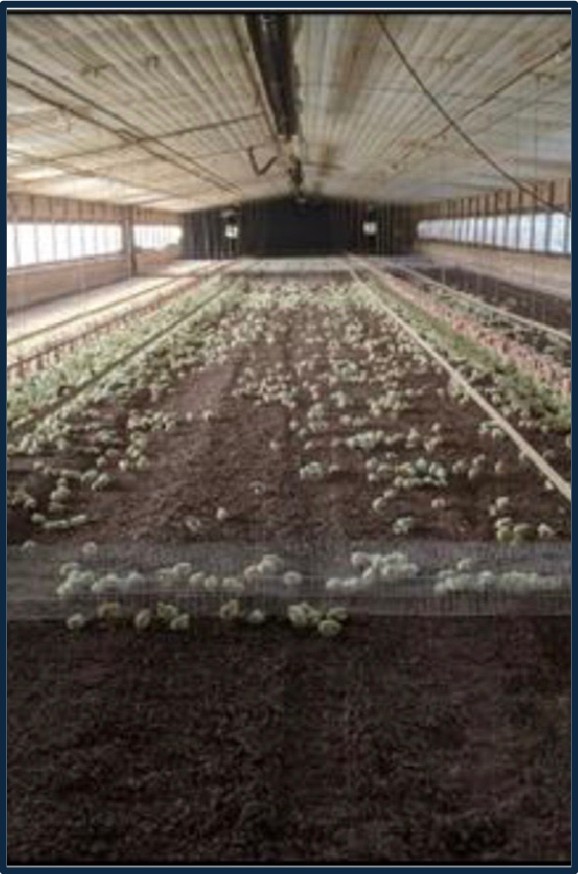
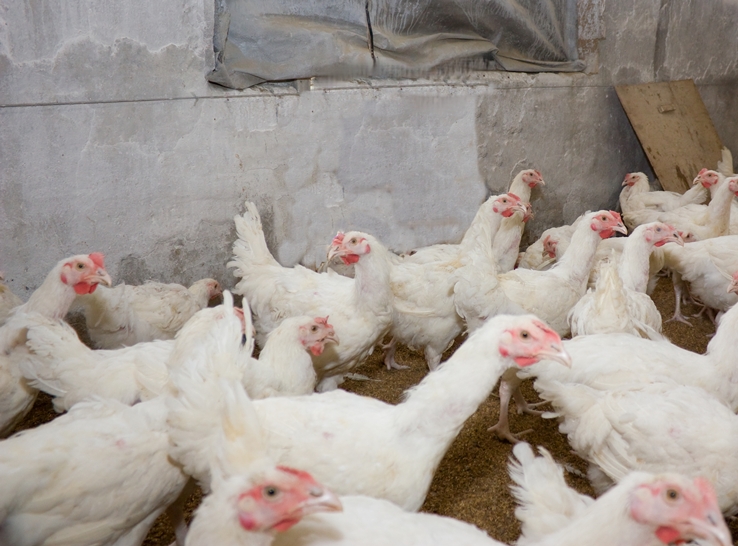
Photo credit: Dr. John Linhoss
Lighting is a very important environmental management tool within modern broiler production. Artificial lighting has long served as the industry standard method of providing light to broiler chickens. This is because artificial light is highly controllable and can provide a consistent, uniform light source. In U.S. commercial settings, broilers are traditionally raised under dim artificial lighting conditions (5-10 lx; Linhoss et al., 2023). Some studies have reported that rearing birds under these conditions improves body weight and feed conversion ratio (Prescott et al., 2003; Aldridge et al., 2022). However, other research suggests that the same environment may negatively affect ocular and leg health (Newberry et al., 1988; Blatchford et al., 2012; Kim et al., 2022).
In recent years, provision of natural light through windows has gained increased attention, as it offers a broader light spectrum that includes UV light and a natural diurnal pattern that cannot be fully replicated by artificial light sources (Prescott et al., 2003). Some animal welfare certification programs require or encourage the installation of windows to allow natural daylight into the barn (e.g., Global Animal Partnership). Access to daylight can create a more dynamic lighting environment compared with fully enclosed houses that rely solely on artificial lighting. Natural light varies throughout the day in both intensity and spectral composition. In contrast, artificial lighting systems typically provide a more constant intensity and spectrum. Producers who participate in these certification programs often incorporate windows as part of their housing design to meet welfare standards, thereby providing birds with natural light.
The avian visual system and commercial poultry lighting
Poultry possess a more advanced visual system than humans (more information on this in our previous newsletter, Vol. 10). Lighting systems used in poultry houses are primarily designed to facilitate human vision and production efficiency, potentially overlooking requirements for functional development of visual abilities in poultry (Prescott et al., 2003). Therefore, there is a movement towards alternative rearing programs that include high light intensities and the provision of natural light in poultry houses. Nevertheless, information on the isolated effects of natural light, in the absence of additional environmental enrichment, on broiler welfare and behavior remains limited.
¿Did you know?
Chickens can detect light flicker that humans cannot because they perceive rapid light changes more easily than we do, with a critical flicker-fusion frequency (CFF) of approximately 90-100 Hz (consciously) compared to about 50-60 Hz in humans. As a result, some artificial lights that appear steady to us may actually flicker from a chicken’s perspective, which may influence their behavior and welfare.
Natural vs. artificial lighting: does it make a difference for broiler welfare and behavior?
Broiler welfare is assessed using a combination of behavioral, physical, and emotional indicators.
Behavioral patterns
Natural light has been shown to impact behavior, with birds reared under natural light displaying more active behaviors, such as walking and standing (Bailie et al., 2013; Sans et al., 2021; Youssef, 2025), whereas those reared under artificial lighting exhibited more resting behavior (Bailie et al., 2013; Youssef, 2025). The provision of natural light also led to more birds interacting with and gathering around the environmental enrichments, as well as exhibiting increased exploratory behaviors such as ground pecking, compared to birds raised under artificial light (Bailie et al., 2013). Additionally, birds raised under natural light have been reported to show increased eating and drinking frequency (Bailie et al., 2013; Fouda et al., 2018; Sans et al., 2021).
Preference tests, in which birds are given a choice between environments (e.g., natural vs. artificial lighting), are used to assess birds’ preferences for environments. In environmentally controlled studies, birds were allowed to move freely between compartments with different lighting conditions, and their location and time spent in each area were recorded. Results indicated that birds tend to spend more time under natural lighting conditions provided through windows, suggesting a preference for this environment (Sans et al., 2021).
Welfare indicators
Common physical parameters used to evaluate welfare status in broilers include footpad dermatitis (FPD), hock burn, gait score, and latency to lie (more information on this in our previous newsletter, Vol. 19). FPD refers to lesions and inflammation of the footpads, whereas hock burn appears as a brown to black discoloration on the hock joint. Both conditions are primarily caused by prolonged contact with wet litter (Mench, 2002; Shepherd and Fairchild, 2010). Gait score is used to assess walking ability and leg health, with higher scores indicating poorer mobility. The latency to lie test measures how long a bird remains standing in shallow water and is commonly used as an indicator of leg strength and comfort. There is a strong negative correlation between latency to lie and gait score, meaning that birds with poorer walking ability (high gait score) lie or sit down quicker in the water during a latency to lie test.
Activity level is closely associated with health and welfare. Increased activity is associated with birds spending less time sitting on wet litter, which may decrease the incidence and severity of contact dermatitis, including FPD, hock burn, and breast burn. A recent study by Youssef et al. (2026) found that broilers reared under natural light had significantly lower FPD scores than those raised under artificial light. However, this difference was not biologically meaningful, as the mean FPD scores in both groups remained below 1 (minimal evidence of footpad dermatitis; Welfare Quality, 2009). In the same study, natural light did not appear to improve hock burn, gait score, or latency to lie. However, when birds were raised either under natural light, or under natural light combined with environmental enrichment, some improvement was seen in latency to lie, but no differences were observed in FPD, hock burn or gait scores (Bailie et al., 2013).
Fear response
Fear tests evaluate birds’ emotional state and how they respond when exposed to a stimulus that may provoke either an approach or avoidance response (Jones, 1996). Several fear tests are currently employed in poultry research, including the novel object test and the novel environment test (more information on this in our previous newsletter, Vol. 33). Research suggests that lighting conditions can influence fear responses in poultry. Birds exposed to natural light or environments with access to windows have shown reduced fearfulness compared with birds reared under solely artificial lighting. For example, broilers raised under artificial light were more reluctant to approach within a 1-m radius of the novel object than broilers exposed to natural light (Youssef et al., 2026). These birds also showed a longer mean latency to approach the novel object (181.4 seconds) compared with birds raised under natural light conditions (69.9 seconds; Youssef et al., 2026). However, natural light did not affect responses in the response to human observer test or novel environment test (Youssef et al., 2026). When natural light was combined with environmental enrichments, there was a tendency for birds raised under natural light to approach the object more in the novel object test (de Jong and Gunnick, 2019). This may indicate that natural light increases bird interest in exploring new things within the environment and reduces neophobia.
¿UV light in poultry houses: what to know?
UV rays can be classified according to their wavelength into three different types: UVA (315-400nm), UVB (280-315nm), and UVC (100-280nm). Research suggests that supplemental UVA lighting may reduce fear responses in broilers, whereas UVB has also been associated with improved skeletal health (Rana and Campbell, 2021). It is unknown if the benefits seen with UV when artificially supplemented or in open sided barns are present when natural light is provided by windows. As the glass used in windows blocks almost all UVB wavelengths (crucial for vitamin D synthesis) and over 90% of UVA wavelengths, limited UV wavelengths reach the birds.
Summary
Although artificial light remains the industry standard for lighting, limited research indicates that natural light may offer some potential welfare-related benefits, such as increased activity, some indication of reduced fearfulness, and birds’ preference for naturally lit areas. However, the results on physical welfare indicators are mixed; therefore, more research is needed to understand natural light’s beneficial effects on broiler health and welfare.
References
Aldridge, D. J., Owens, C. M., Maynard, C., Kidd, M. T., and Scanes, C. G., 2022. Impact of light intensity or choice of intensity on broiler performance and behavior. J. Appl. Poult. Res., 31(1):100216.
Bailie, C. L., Ball, M. E. E., and O’Connell, N. E., 2013. Influence of the provision of natural light and straw bales on activity levels and leg health in commercial broiler chickens. Animal 7:618–626.
Blatchford, R. A., Archer, G. S., and Mench, J. A., 2012. Contrast in light intensity, rather than day length, influences the behavior and health of broiler chickens. Poult. Sci., 91:1768-1774.
de Jong, I. C., and Gunnink, H., 2019. Effects of a commercial broiler enrichment programme with or without natural light on behaviour and other welfare indicators. Animal 13:384-391.
Fouda, M. M., Darwish, R. A., Abou-Ismail, U. A., and Mohammed, A. S., 2018. Comparative effects of natural and artificial light on behaviour, performance, and welfare of broiler chickens. Mansoura Vet. Med. J., 19(1):321-332.
Jones, R. B., 1996. Fear and adaptability in poultry: insights, implications, and imperatives. World’s Poult. Sci. J., 52:131-174.
Kim, H. J., Son, J., Kim, H. S., Hong, E. C., and Kim, J. H., 2022. Effects of light intensity on growth performance, blood components, carcass characteristics, and welfare of broilers. J. Anim. Sci. Tech., 64:985–996.
Linhoss, J. E., Davis, J. D., Campbell, J. C., Purswell, J. L., Griggs, K. G., and Edge, C. M., 2023. Light intensity and uniformity in commercial broiler houses using lighting programs derived from Global Animal Partnership (GAP) lighting standards. J. Appl. Poult. Res., 32:100309.
Mench, J. A., 2002. Broiler breeder: feed restriction and welfare. World’s Poult. Sci. J., 58:23-29.
Newberry, J. C., Hunt, J. R., and Gardiner, E. E., 1988. Influence of light intensity on behavior and performance of broiler chickens. Poult. Sci., 67:1020-1025.
Prescott, N. B., Wathes, C. M., and Jarvis, J. R., 2003. Light, vision and the welfare of poultry. Anim. Welf., 12:269-288.
Rana, M. S. and Campbell, D. L. M., 2021. Application of Ultraviolet light for poultry production: A review of impacts on behavior, physiology, and production. Front. Anim. Sci., 2:699262.
Sans, E. C. d. O., Tuyttens, F. A. M., Taconeli, C. A., Pedrazzani, A. S., Vale, M. M., and Molento, C. F. M., 2021. From the point of view of the chickens: what difference does a window make? Animals 11(12):3397.
Shepherd, E. M., and Fairchild, B. D., 2010. Footpad dermatitis in poultry. Poult. Sci., 89(10):2043-2051.
Welfare Quality, 2009. Welfare quality assessment protocol for poultry (Broilers, Laying hens).
Youssef, T., 2025. Impact of natural and artificial light treatments on welfare and behavior in commercial broilers. M.S. Thesis. Auburn University.
Youssef, T., Jackson, A., Bourassa, D., Linhoss, J., and Baker-Cook, B., 2026. Evaluating the impact of natural and artificial light treatments on fear response and welfare parameters in commercial broilers. Poult. Sci., 105(3):106343.
To view all issues of Poultry Press, click here.
Editor’s note: Content on Modern Poultry’s Industry Insights pages is provided and/or commissioned by our sponsors, who assume full responsibility for its accuracy and compliance.