




By researching the impact of ectoparasite infestations in laying hens through a behavioral lens, Purdue University doctoral student Haley Sutherland aims to identify characteristics or heritable traits that help hens resist mite infestations. She shared her research during a November 2025 Poultry Extension Collaborative webinar.
“Mite infestations are known to lower feed conversion, decrease egg production, reduce bodyweight and increase hen mortality,” Sutherland said.
She noted that infestations represent a significant expense, costing the egg industry .07 to .10 cents per bird over 10 weeks.
“Northern fowl mites are especially problematic because one female mite can kick-start an infestation. Control and treatment are difficult because the mite population on each hen can vary widely,” Sutherland noted.
Cage-free birds present additional challenges. More bird interactions in cage-free systems increase mite transmission and make catching and treating birds more challenging.
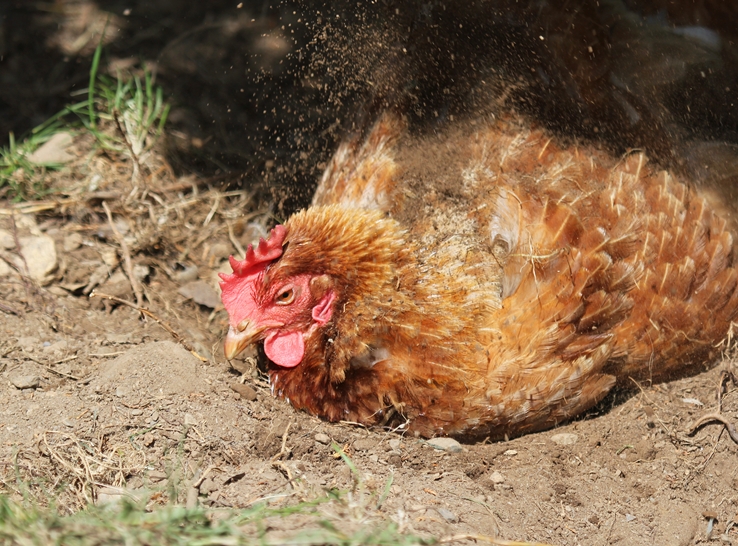
“Wild birds successfully mitigate infestations through preening, dustbathing, increasing nutrient intake, nest maintenance behavior to remove mites from nests and migration. Housed birds have fewer options available to them, mostly limited to preening and dustbathing.”
However, hens can increase the frequency and duration of preening and dustbathing.
Study details
Sutherland’s project identified and documented behavioral differences in laying hens with high and low levels of northern fowl mite infestation.
The birds were infected with 50 female mites at 24 weeks of age. Continuous video recording captured behaviors. When the hens were 30 and 40 weeks old, Sutherland conducted twice-daily observations of the behavior of the hens in each pen with the highest and lowest infestation rates, from 6:00 a.m. to 6:15 a.m. and again from 2:00 p.m. to 2:15 p.m. After identifying the individuals with the highest and lowest infestations, she retrospectively reviewed the behaviors displayed at 20 weeks.
“At 20 weeks, none of the hens had mites. At 30 weeks of age, infestations were near the peak. At 40 weeks, infestations were decreasing,” Sutherland noted.
Behavioral data
The behaviors that Sutherland examined were eating, foraging, pecking and preening. She observed behavioral differences by age and infestation level.
At 20 weeks of age, the birds that later had higher infestations ate more frequently in the afternoon than the low-infestation birds; this trend was also seen at 30 weeks of age. For foraging behavior, low-infestation birds foraged more in the morning at 20 and 30 weeks than high-infestation birds. However, analyzing the 30-week data, low-infestation birds foraged more frequently in the afternoon than in the morning.
Low-infestation birds also displayed more environmental pecking than high-infestation birds, and the low-infestation birds pecked more in the morning.
At 40 weeks of age, with decreasing infestation, hens with lower infestations ate more in the morning and stood, walked and preened more in the afternoon than hens with higher infestations. The hens with higher infestations continued to eat more in the afternoon, stood longer in the morning and showed more environmental pecking in the afternoon.
The only difference Sutherland observed in preening behavior occurred at 40 weeks, with high-infestation birds preening more in the morning than in the afternoon.
She also noted that no behavioral duration differences were observed at 20 weeks but were most noticeable at peak infestation duration. Frequency variations showed the greatest change when the infestation was declining.
Study limitations
Sutherland commented that the times chosen for observation might have affected the results, and more research is necessary. “The differences seen in the study were associated only with the frequency of common behaviors or long-duration behaviors,” she said.
In the future, Sutherland aims to include more birds in the study and use additional observation methods.
Looking forward
Sutherland hopes her research will lead to breeding laying hens that are not impacted by mite infestations.
However, she noted that the current research findings can be applied across species, integrated with existing pest-management plans and used to prevent adverse effects on productivity and welfare without contributing to pesticide resistance.
“By honing in on behavioral and immune response to infestation, we may be able to identify heritable traits and individual characteristics associated with ectoparasite resistance and resilience and better manage fowl mite infestations,” Sutherland concluded.