



By Chloe “Leo” Phelps, Virginia Tech and Leonie Jacobs, PhD, Virginia Tech
Boredom is a negative emotional state that may be caused by barren environments. Therefore, it may be a welfare concern for poultry that are raised in barren conditions.
However, researchers have conducted few investigations into this emotional state. Approaches to detect boredom in other species may provide practical methods for quantifying boredom in poultry.
What is boredom?
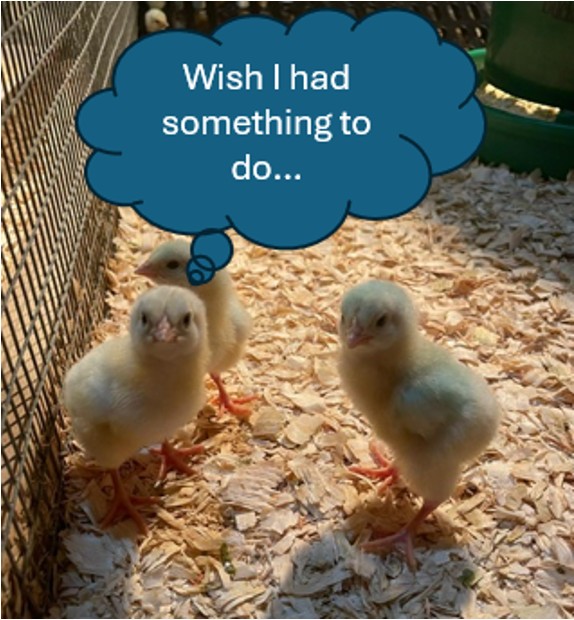
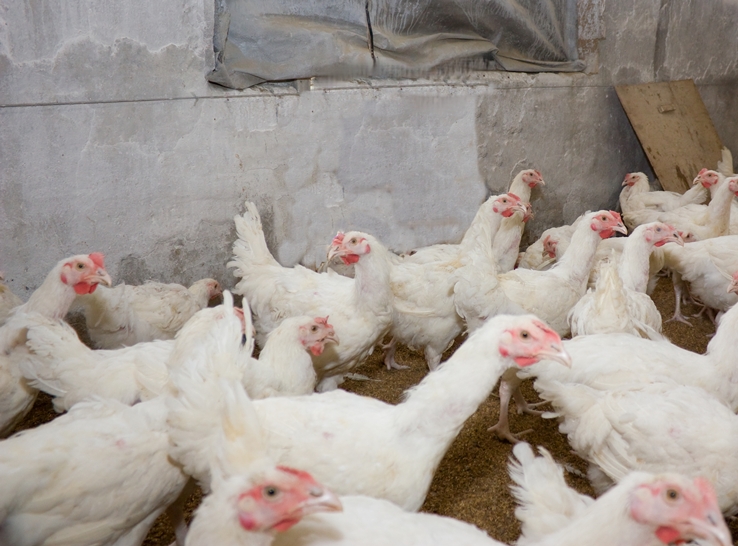
Figure 1. A group of chicks in an experimental pen. Besides food, water, litter, and pen mates, other resources are lacking. Photo credit: Leo Phelps, Virginia Tech.
Boredom is an unpleasant emotional state resulting from an unfulfilled motivation for sufficiently stimulating experiences.1 This means that three criteria must be met for the experience of boredom: 1) a desire or “want” for an experience or activity, 2) an environment which fails to meet that desire, and 3) discomfort experienced from the unmet desire.2 To date, it is unclear whether poultry experience boredom. While boredom is sometimes argued to be a result of modern human lifestyles, it is likely that this state is shared with domesticated and farmed species living in our care.
Boredom in livestock, including poultry, receives less attention than some other negative psychological states such as fear, anxiety, and depression, possibly because it has been perceived as less severe.2 However, it may be no less harmful. Bored people have an increased risk of anxiety and depression, poor health, and mortality.3,4 In rodents and cattle, boredom was linked to sensation seeking, excess inactivity, and stereotypic behaviors.5–8 Boredom can also increase an animal’s behavioral response to all types of stimuli, including negative ones. Boredom can be a long-lasting negative state and can therefore have significant health and welfare consequences when it is inescapable.
Do poultry have the capacity for boredom?
For poultry to experience boredom, they must have the capacity for each of the characteristics in the definition of boredom. Poultry have wants, needs, and preferences, indicating they can desire certain experiences or activities. It is likely that these desires can go unfulfilled in an under stimulating environment, like in barren housing conditions on farms.9,10 This could lead to a negative emotional state11. Thus, poultry may meet the three criteria for boredom.
Poultry desire experiences and activities
The motivation of birds to perform specific natural behaviors is well-demonstrated. For example, some motivated behaviors in poultry include foraging and dust-bathing. Strong motivations for these behaviors have been demonstrated through the birds’ willingness to pay a cost to access opportunities for these behaviors12,13 and their continued performance of the behavior regardless of environmental conditions.14–17 Birds also demonstrate increased performance of the behavior if they are temporarily prevented from it, which shows that their motivation continues to increase with a lack of performance.18 If birds cannot perform these specific behaviors, they may experience negative affective states such as frustration.19,20
A parallel can be drawn between the motivation for these specific behaviors and the motivation for activity or stimulation more generally. Broilers appear to have a preference for novel items that stimulate exploration and provide sensory stimulation and will actively engage with such stimuli.21 They entered spaces with novel items faster than empty spaces,22 which may indicate greater motivation for environments with more stimulation and options for engagement. Finally, they preferred complex, moving screensavers over those that were simpler,23 which similarly demonstrates a desire for sensory stimulation. If a lack of varied stimulation can cause a negative state, similar to how a lack of foraging can cause frustration, this would mean that they are experiencing boredom.
Poultry wants and needs may go unfulfilled in understimulating environments
Poultry are commonly raised in understimulating or monotonous environments as most commercial environments provide access to feed, water and flock mates, but not much else. These environments provide few sensory stimuli and few behavioral opportunities compared to the natural environments in which the ancestors of poultry species evolved. These barren environments lead to increased negative states such as anxiety, fear, and chronic stress while adding complexity (and therefore behavioral opportunities and stimulation) can decrease the birds’ experiences of these states.24–26 It may be the case that, similar to in humans, boredom may be a contributing factor to the increased anxiety and depression experienced in barren environments. More complex environments meet the birds’ behavioral motivations, including the motivation for behavioral variety and stimulation, leading to less boredom, reduced overall negative states, and therefore better welfare. Several PEC Poultry Press articles have discussed the importance of environmental complexity for poultry welfare such as Issues 13, 52, and 57.
How can boredom be assessed?
Scientific investigation into this topic has only just begun, and more research will be needed to help further understand this topic. To demonstrate that boredom in poultry exists, researchers may use behavioral indicators as cues to infer their internal emotional state.
Research in other species can help identify behavioral indicators that may be useful to identify boredom in poultry. Mink housed in barren cages were abnormally inactive and they were more motivated to contact novel objects, even those that would typically be aversive, compared to an enriched group.7,28 Cattle in unenriched environments were similarly more inactive and spent more time seeking stimulation than those housed with enrichments.6 Motivation to contact any type of stimuli, including normally aversive ones, is a promising measure for boredom because motivation for any stimulation not just specific or positive stimulation differentiates boredom from other negative emotions such as frustration and apathy. While all three can be elicited by behavioral deprivation, frustration refers to a negative response to a specific expectation being violated while apathy involves a lack of any motivation.29–31
Research into this topic has only just begun in poultry. However, some ongoing research funded by the organization Kinder Ground32,33 is investigating using motivation to contact aversive objects as a measure for boredom in broiler chickens. This study aims to replicate the findings in mink to demonstrate the possibility of boredom in broilers (Figure 2). Boredom tests may have potential for integration into welfare assessment protocols to determine impacts of new enrichment types, ensuring that this negative state is prevented.
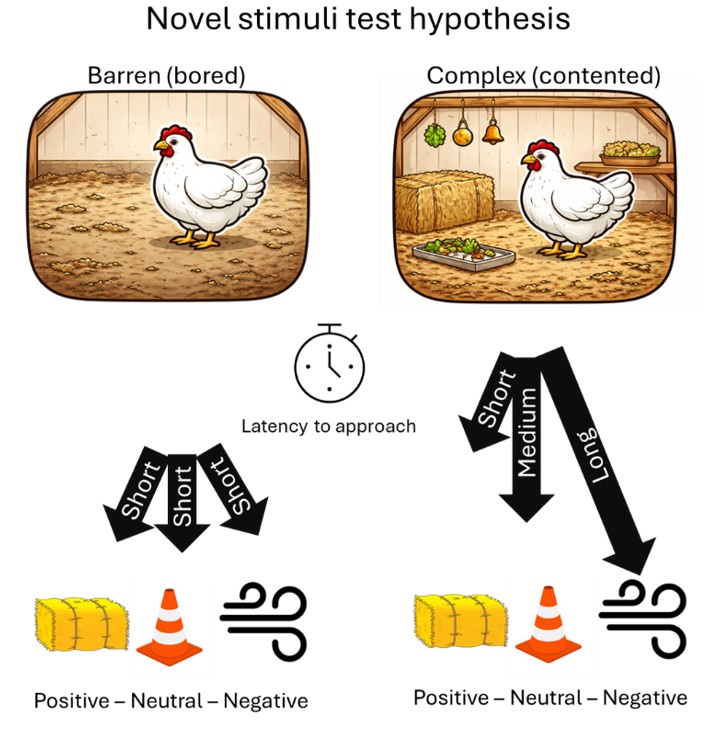
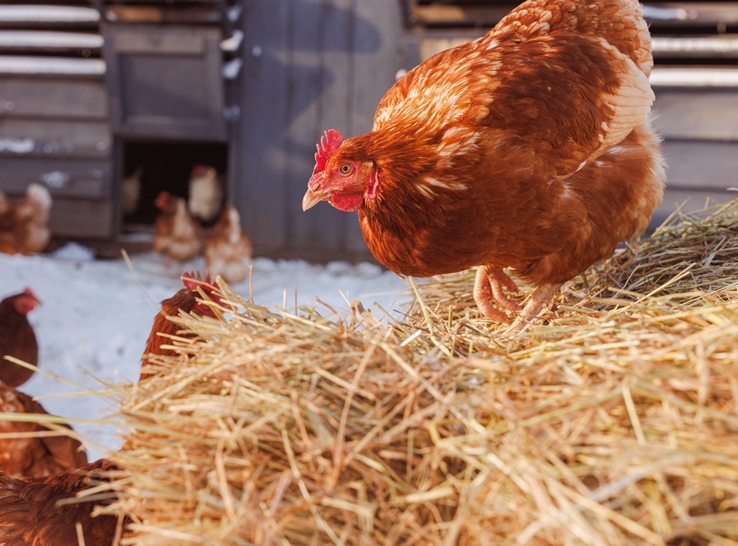
Figure 2. The novel stimuli test may be key to detect boredom in broilers raised in barren environments, compared to those in complex environments. Here, the positive object is a hay bale, the neutral object is a cone, and the negative object is a puff of air. We hypothesize that bored broilers will interact with all objects equally, because ‘any stimulation’ is better than nothing. They would show a short latency to approach all objects. In contrast, the contented broilers will mostly engage with the positive object.
Summary: Boredom in poultry
- Boredom is an emotional state defined by an unpleasant unfulfilled desire for an experience or activity, likely induced by a barren environment.
- Boredom may be a welfare concern in poultry because they appear to be motivated to interact with novelty, show preferences, and are commonly housed in barren environments.
- Providing animals with positive, neutral, and negative novel items could be developed into a test to detect boredom.
- Understanding boredom in poultry can help determine the impacts of housing conditions, especially related to environmental complexity.
Works cited
- Bench, S. W. & Lench, H. C. On the Function of Boredom. Behav. Sci. 3, 459–472 (2013).
- Burn, C. C. Bestial boredom: a biological perspective on animal boredom and suggestions for its scientific investigation. Anim. Behav. 130, 141–151 (2017).
- Britton, A. & Shipley, M. J. Bored to death? Int. J. Epidemiol. 39, 370–371 (2010).
- Li, J., Kaltiainen, J. & Hakanen, J. J. Job boredom as an antecedent of four states of mental health: life satisfaction, positive functioning, anxiety, and depression symptoms among young employees – a latent change score approach. BMC Public Health 24, 907 (2024).
- Hintze, S., Maulbetsch, F., Asher, L. & Winckler, C. Doing nothing and what it looks like: inactivity in fattening cattle. PeerJ 8, e9395 (2020).
- Russell, A. L., Randall, L. V., Eyre, N., Kaler, J. & Green, M. J. Novel enrichment reduces boredom-associated behaviours in housed dairy cows. JDS Commun. https://doi.org/10.3168/jdsc.2023-0475 (2024) doi:10.3168/jdsc.2023-0475.
- Meagher, R. K. & Mason, G. J. Environmental Enrichment Reduces Signs of Boredom in Caged Mink. PLoS ONE 7, e49180 (2012).
- (PDF) The concept of animal boredom and its relationship to stereotyped behaviour. ResearchGate https://www.researchgate.net/publication/286694799_The_concept_of_animal_boredom_and_its_relationship_to_stereotyped_behaviour (2025).
- Marino, L. Thinking chickens: a review of cognition, emotion, and behavior in the domestic chicken. Anim. Cogn. 20, 127–147 (2017).
- Riber, A. B., van de Weerd, H. A., de Jong, I. C. & Steenfeldt, S. Review of environmental enrichment for broiler chickens. Poult. Sci. 97, 378–396 (2018).
- Fraser, D. & Duncan, I. J. H. ‘Pleasures’,’Pains’ and Animal Welfare: Toward a Natural History of Affect. Anim. Welf. 7, 383–396 (1998).
- Olsson, I. a. S. & Keeling, L. J. The Push-Door for Measuring Motivation in Hens: Laying Hens are Motivated to Perch at Night. Anim. Welf. 11, 11–19 (2002).
- Bubier, N. E. The behavioural priorities of laying hens: the effect of cost/no cost multi-choice tests on time budgets. Behav. Processes 37, 225–238 (1996).
- Rodenburg, T. B. et al. The prevention and control of feather pecking in laying hens: identifying the underlying principles. Worlds Poult. Sci. J. 69, 361–374 (2013).
- Nørgaard-Nielsen, G. & Vestergaard, K. Dustbathing Behaviour of Uropygial Gland Extirpated Domestic Hens. Acta Vet. Scand. 22, 118–128 (1981).
- Olsson, I. a. S. & Keeling, L. J. Sham dustbathing and use of dustbaths in furnished cages for laying hens. Proc. Br. Soc. Anim. Sci. 2002, 224–224 (2002).
- Vestergaard, K. S., Damm, B. I., Abbott, U. K. & BildsøE, M. Regulation of dustbathing in feathered and featherless domestic chicks: the Lorenzian model revisited. Anim. Behav. 58, 1017–1025 (1999).
- Weeks, C. A. & Nicol, C. J. Behavioural needs, priorities and preferences of laying hens. Worlds Poult. Sci. J. 62, 296–307 (2006).
- Zimmerman, P. H., Koene, P. & van Hooff, J. A. R. A. M. Thwarting of behaviour in different contexts and the gakel-call in the laying hen. Appl. Anim. Behav. Sci. 69, 255–264 (2000).
- The vocal expression of feeding motivation and frustration in the domestic laying hen, Gallus gallus domesticus – ScienceDirect. https://www-sciencedirect-com.ezproxy.lib.vt.edu/science/article/pii/S0168159100001362?casa_token=4PXaaPzahtgAAAAA:Gmdt2OJjHBMRctGlz-KuDV9KzxauDYrdk35cZqGc6kBe1PcECAi_Owx7TgZkuOu_uB5giftODn4.
- Forkman, B., Boissy, A., Meunier-Salaün, M.-C., Canali, E. & Jones, R. B. A critical review of fear tests used on cattle, pigs, sheep, poultry and horses. Physiol. Behav. 92, 340–374 (2007).
- Newberry, R. C. Exploratory behaviour of young domestic fowl. Appl. Anim. Behav. Sci. 63, 311–321 (1999).
- Clarke, C. H. & Jones, B. R. Domestic Chicks’ Attraction to Video Images: Effects of Stimulus Movement, Brightness, Colour and Complexity. Int. J. Comp. Psychol. 13, (2000).
- Silva, M. I. L. da et al. Behaviour and animal welfare indicators of broiler chickens housed in an enriched environment. PLOS ONE 16, e0256963 (2021).
- Effect of Environmental Complexity and Stocking Density on Fear and Anxiety in Broiler Chickens. https://www.mdpi.com/2076-2615/11/8/2383 (2025).
- Anderson, M. G. et al. Effect of Environmental Complexity and Stocking Density on Fear and Anxiety in Broiler Chickens. Animals 11, 2383 (2021).
- Campbell, A. M., Anderson, M. G. & Jacobs, L. Measuring Chronic Stress in Broiler Chickens: Effects of Environmental Complexity and Stocking Density on Immunoglobulin-A Levels. Animals 13, 2058 (2023).
- Meagher, R. K., Campbell, D. L. M. & Mason, G. J. Boredom-like states in mink and their behavioural correlates: A replicate study. Appl. Anim. Behav. Sci. 197, 112–119 (2017).
- Mason, G. J. & Burn, C. C. Frustration and boredom in impoverished environments. Anim. Welf. 114–138 (2018) doi:10.1079/9781786390202.0114.
- Meagher, R. K. Is boredom an animal welfare concern? Anim. Welf. 28, 21–32 (2019).
- Duncan, I. J. Behavior and behavioral needs. Poult. Sci. 77, 1766–1772 (1998).
- Bored Broilers. Kinder Ground https://kinderground.org/our-efforts/bored-broilers/.
- Elizabeth, J. & Reimert, I. ISAE 2025 Conference Proceedings. 4-8 August 2025 Utrecht, The Netherlands.
To view all issues of Poultry Press, click here.
Editor’s note: Content on Modern Poultry’s Industry Insights pages is provided and/or commissioned by our sponsors, who assume full responsibility for its accuracy and compliance.