




Feature photo credit: Zoetis, Inc.
By Abigail Graham, DVM, MAM, DACPV, Associate Director, Poultry Technical Services at Zoetis
Imagine this: You’re a veterinarian and at one of the farms you oversee, flock performance is down and mortality is up. You take appropriate steps to identify the disease challenge, using field surveillance and diagnostics. Then, you select vaccines suited to the current strains threatening a flock. The vaccine arrives, and your new vaccination program begins; but weeks later, flock performance does not improve as expected.
Is the vaccine not living up to its claims? Was the wrong vaccine selected?
When vaccine decisions are grounded in sound diagnostics and veterinary guidance, the vaccine itself may not be the problem. It may be time to review how the product was stored, prepared and applied.
Vaccines must remain viable throughout the entire process from delivery and storage through mixing, administration and bird exposure. A breakdown at any point may reduce the amount of viable vaccine that reaches the target tissue and impact the immune response.
1. Are label instructions being followed?
Every vaccine has specific requirements for storage, preparation, dose, application method and time of use after mixing. Those instructions should form the foundation of the vaccination protocol.
Different vaccine formats also require different handling practices. Frozen, freeze-dried and emulsified vaccines should not be treated interchangeably. Teams need product-specific standard operating procedures and training that cover:
- Required storage and transport temperatures
- Appropriate diluent and water requirements
- Thawing or reconstitution procedures
- Mixing order and technique
- Maximum time between preparation and administration
- Correct dose and application method
Timing and temperature are especially important, because live vaccines can lose viability when exposed to unfavorable conditions or held too long after preparation.
For example, for frozen vaccine, the total time span from removing ampules from liquid nitrogen to thawing and adding to diluent should be no more than three minutes. A longer time span may compromise vaccine cell livability and reduce vaccine efficacy.
2. Is the in ovo vaccination process being protected?
Successful in ovo vaccination depends on following specific processes for vaccine preparation, sanitation, consistent management of the vaccination equipment and more.
The vaccine preparation room should be clean, controlled and used for its intended purpose only. Work surfaces, thaw baths and equipment need to be cleaned and disinfected before vaccine preparation. And it’s important to limit traffic through in this area to reduce opportunities for contamination or product mix-ups.
Day-to-day management of the in ovo vaccination system is equally important. Hatchery teams should follow a checklist for setup, shutdown, cleaning and storage. This includes properly sanitizing the vaccine pathway within the device.
Small deviations can become significant when multiplied across hundreds of thousands of eggs. A missed cleaning step, extended vaccine-thawing time or inconsistent preparation procedure could impact downstream flock health.
3. Is the spray cabinet applying optimal coverage?
Spray cabinet vaccination allows an entire basket of chicks to be vaccinated quickly, but application must be consistent. The goal is to deliver viable vaccine droplets to the eyes, nares and mouth, where the vaccine can contact the appropriate tissues and initiate an immune response.
Some factors that deserve close attention include:
- Application volume. The spray process must deliver the intended amount of vaccine solution to every chick basket with equal volume dispensed from each nozzle.
- Droplet size and coverage. Droplets that are too small may evaporate or create gaps in coverage, and it’s critical the entire area within the chick basket is covered.
- Nozzle condition. Worn or clogged nozzles can alter the spray pattern and droplet size.
At startup, assess the spray pattern by using a quality control plate or another approved method. Nozzles, syringes and tubing should also be cleaned or replaced according to a defined schedule.
4. Are field vaccination practices uniform?
Vaccination practices in growout houses present a different set of variables.
For drinking-water vaccination, the objective is to deliver viable vaccine through the water system and have the entire flock consume it within a relatively short period.
Water treatment that could damage the vaccine should be discontinued according to protocol. Lines need to be charged uniformly, and birds should be encouraged to drink through appropriate water withdrawal, line management and movement through the house.
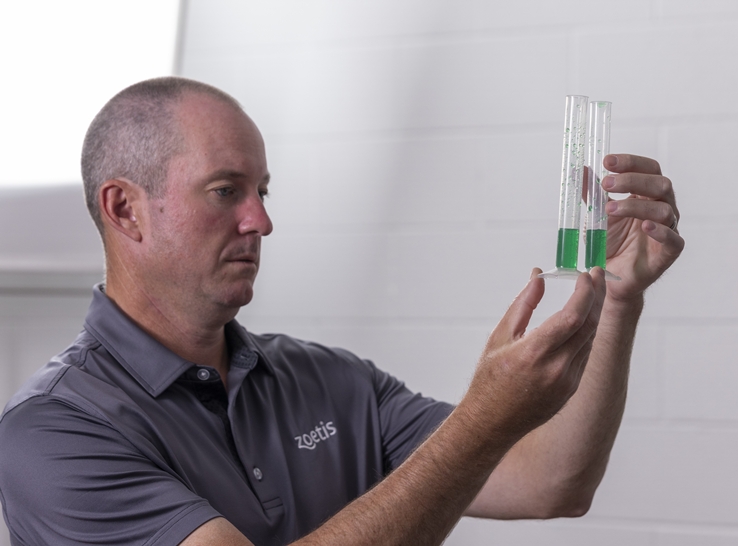
Dye in the vaccine solution can help confirm that vaccine reached the birds. Tongue checks shortly after the vaccine is consumed provide a helpful indication of flock exposure.
For backpack spraying, application uniformity depends on bird density, walking speed, spray volume and droplet distribution. A dry run with water-sensitive paper can help teams evaluate coverage before applying vaccine. It’s recommended to reassess periodically and whenever personnel change.
5. Are you inspecting for what you expect?
A completed vaccination procedure does not automatically confirm successful application.
Vaccine-take monitoring can help determine whether live vaccine reached the birds and replicated as expected. Depending on the vaccine, this may involve physical checks or diagnostics such as PCR.
For respiratory vaccines such as infectious bronchitis virus or Newcastle disease virus, PCR testing from samples collected from appropriate tissue a few days after vaccination can provide information about the uniformity of vaccine exposure. Poor or inconsistent results can help direct the investigation back toward mixing, handling, spray settings or environmental conditions.
One result is only a snapshot, but routine monitoring can establish a baseline, identify changes and help guide corrective action.
Vaccine application fundamentals are not complicated
The fundamentals of vaccine application are not complicated, but they require monitoring to sustain success. Clear protocols, regular routine training, properly maintained equipment and verification tools help protect the vaccine investment and give each flock an opportunity to develop the intended immune response. Turnover can contribute to gaps in consistency or understanding of proper vaccine application protocols.
Zoetis has created an extensive and growing Poultry Vaccine Administration resource hub of vaccine application best practices. The materials include resources for broilers, layers and turkeys. There are videos and PDF guides, with several Spanish-language resources, covering the multitude of application methods.
Zoetis also offers comprehensive diagnostic services that can help you identify disease challenges and evaluate vaccine response in your birds. Contact your Zoetis representative to learn more.
All trademarks are the property of Zoetis Services LLC or a related company or a licensor unless otherwise noted.
Editor’s note: Content on Modern Poultry’s Industry Insights pages is provided and/or commissioned by our sponsors, who assume full responsibility for its accuracy and compliance.