






By Eric Shepherd, DVM, Zoetis
Late spring and early summer are good times to take a fresh look at infectious bursal disease (IBD) vaccination strategies. Re-evaluating your approach can help support more consistent bird performance and strengthen immunity across flocks.
Today’s poultry operations have many tools to address disease pressure, but relying too heavily on any one vaccination approach can lead to diminishing returns over time.
In IBD programs, for example, staying on the same vector-vaccine program year after year may create conditions in which a field-virus challenge breaks through earlier over successive flocks. As poultry veterinarians evaluate seasonal vaccination strategies, a rotation to an immune-complex vaccine for IBD is worth considering as a complement to a vector vaccination program.
This type of rotation is a strategic effort to use live vaccines in a way that may help disrupt field-virus pressure, restore disease control and support overall flock health.
Displacing wild-type IBD
For IBD, the live immune-complex vaccine Poulvac® Bursaplex® has been shown to help block and displace wild-type variant viruses,1 thereby reducing field challenge and helping position vector vaccines to regain efficacy when reintroduced into the vaccine rotation.2,3
Timing is critical. The first 3 weeks post-hatch are a key risk window for IBD infection. IBD protection starts with hyper-immunizing breeder hens to provide robust maternal antibodies, while strategically vaccinating broiler chicks — including in ovo — can provide complementary protection during this early challenge window.
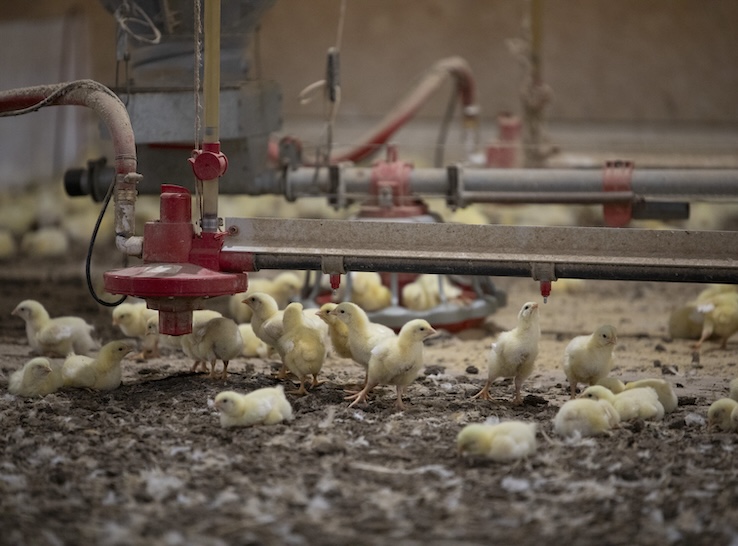
Photo credit: Zoetis, Inc.
Poultry complexes that have relied heavily on herpesvirus of turkey (HVT)-vectored IBD vaccines have seen their variant challenge window shift progressively earlier over time.4 When that happens, there is greater potential for immune suppression before vectored vaccines elicit protection in young broilers. That can create conditions for other diseases, such as inclusion body hepatitis (IBH), to gain a foothold. IBH is a notable cause of broiler mortality during the first 3 to 4 weeks of life.
A field trial evaluated the effectiveness of the live immune-complex vaccine, Poulvac Bursaplex, in a commercial broiler complex facing a high-variant IBDV challenge.5 Investigators assessed bursal surveys and flock-level performance measures to evaluate vaccine effectiveness.
Relative to pre-vaccination performance, flocks in the study that were vaccinated with Poulvac Bursaplex improved in every measured performance category:6
- 15 points of bodyweight
- 6 points of adjusted feed-conversion ratio
- 4% livability
- 13% condemnations
- 7 cents per pound bodyweight decrease in live cost
Although this complex benefited significantly from the switch to an immune-complex vaccine, each complex may experience its own results after introducing Poulvac Bursaplex.
In the field trial, once Poulvac Bursaplex was introduced into the vaccine program, the complex reported immediate improvements in bursal health, bird health and performance, and a reported reduction in IBH-associated mortality.
Seasonal use of Poulvac Bursaplex has been associated with “crowding out” field-virus types over time, with fewer wild types present and a later challenge window after annual use of the immune-complex vaccine.7 In turn, that shift may help vectored IBD vaccines perform better in the future by reducing early field challenge. A major purpose of immune-complex vaccines is to reset challenge-virus pressure year after year and decrease pressure on future vaccine programs.
Developing a rotational IBD vaccine program that includes both immune-complex and HVT-vectored vaccines has shown benefits by helping protect against and reduce persistent variant IBD challenges in the field.8
Holistic view of vaccine selection
A holistic understanding of field-virus challenge can help shape vaccine-program recommendations and provide insight into the likely impact of implementing a new program, regardless of disease challenge.
For IBD, active bursal-surveillance programs using bursa boards and bursal surveys can help monitor which IBDV strains are present in a complex and the ages at which those strains are challenging birds. Knowing when a challenge is breaking through has important implications for broiler health programs, as well as breeder programs.
Additional diagnostic tools, including polymerase chain reaction and enzyme-linked immunosorbent assays, can help determine which viral strains are present in a flock. That information can help poultry veterinarians select vaccines that better match the field challenge and help flocks reach their performance potential.
References
- Muniz EC, Verdi R, Jackwood DJ, et al. Molecular epidemiologic survey of infectious bursal disease viruses in broiler farms raised under different vaccination programs. J Appl Poult Res. 2018;27:253-261.
- Ibid.
- Ashraf S, Abdel-Alim G, Al-Natour MQ, Saif YM. Interference between mild and pathogenic strains of infectious bursal disease virus in chickens. Avian Dis. 2005;49:99-103.
- Shepherd E, Cummings T, Jordan B, Cookson K. Field experiences with a live immune-complex IBD vaccine in broilers in the Southeast USA. In: Proceedings, International Poultry Science Forum, 2026.
- Ibid.
- Ibid.
- Muniz EC, Verdi R, Jackwood DJ, et al. Molecular epidemiologic survey
- Shepherd E, Cummings T, Jordan B, Cookson K. Field experiences with a live immune-complex
Editor’s note: Content on Modern Poultry’s Industry Insights pages is provided and/or commissioned by our sponsors, who assume full responsibility for its accuracy and compliance.
Feature photo credit: Zoetis, Inc.