



By Alexandra Ulans, PhD, and Allison Pullin, PhD, North Carolina State University
In the United States, the majority of laying hens are housed in conventional cages. However, there has been a shift towards cage-free systems. Ten states, including California, Washington, and Michigan, passed legislation to phase-out conventional cages, and several retailers and restaurants, like McDonalds, Starbucks, and Costco, pledged to sell cage-free eggs. As of 2026, 47.7% of all hens are raised in cage-free systems, but up to 75% of hens will need to be housed cage-free to meet consumer demand (USDA, 2026).
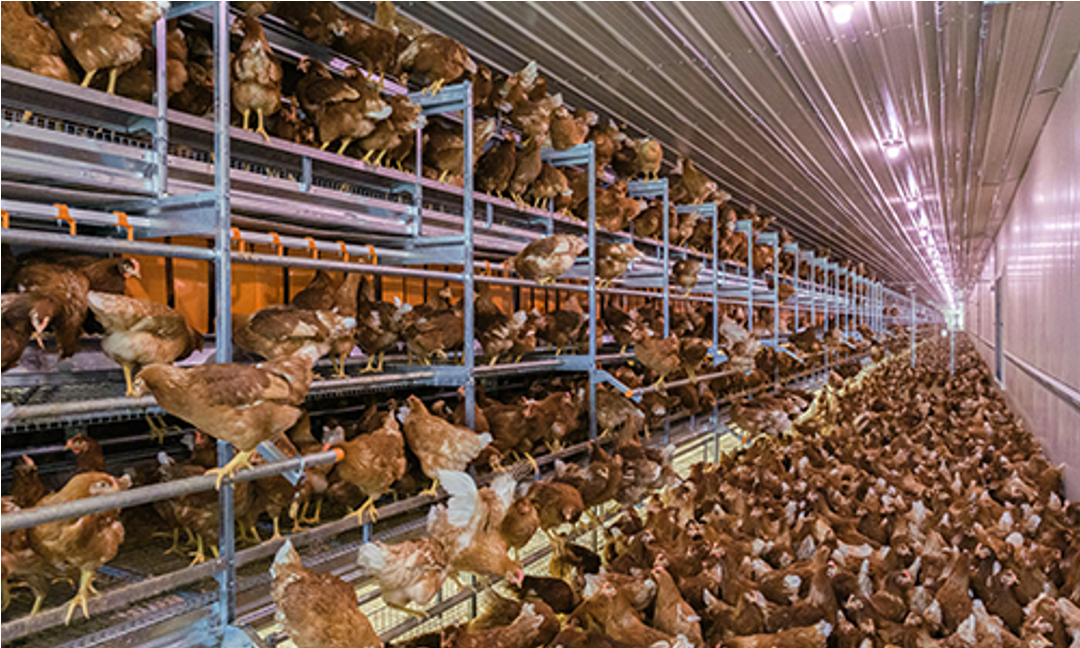
Figure 1. Image of a cage-free, multi-tier aviary Photo credit: Big Dutchman
Cage-free systems can benefit laying hen welfare. Birds have opportunities to perform a full range of species-specific behaviors, including foraging, dustbathing, perching, and walking, which are restricted in conventional cages (Lay et al., 2011).
Commercial cage-free farms often use multi-tier aviary housing systems with two to four elevated levels that contain resources, such as feeders, drinkers, perches, nest boxes, and an adjacent litter area. Hens are highly motivated to access these resources, and adequate provision is important for supporting both behavioral expression and physiological requirements (reviewed in Weeks & Nicol, 2006).
Resources
Litter areas refer to spaces on the floor that are filled with substrate, commonly wood shavings (Figure 2). Hens use this substrate to forage or dust bathe. Foraging is a highly motivated behavior, and under natural or semi-natural conditions, hens spend the majority of their active time searching, scratching, and pecking at the substrate (reviewed in Weeks & Nicol, 2006). Limited access to foraging substrate may cause hens to redirect pecking motivations towards other hens’ feathers, resulting in feather pecking that can cause pain, injuries, and distress (Dixon, 2008). Dust bathing is a comfort behavior that maintains feather condition (van Liere & Bokma, 1987; see more at Vol. 54). Crowding and piling in litter areas can occur during peak use, suggesting that insufficient litter space and social behavior dynamics may limit behavioral expression and risk smothering (Campbell et al., 2016).
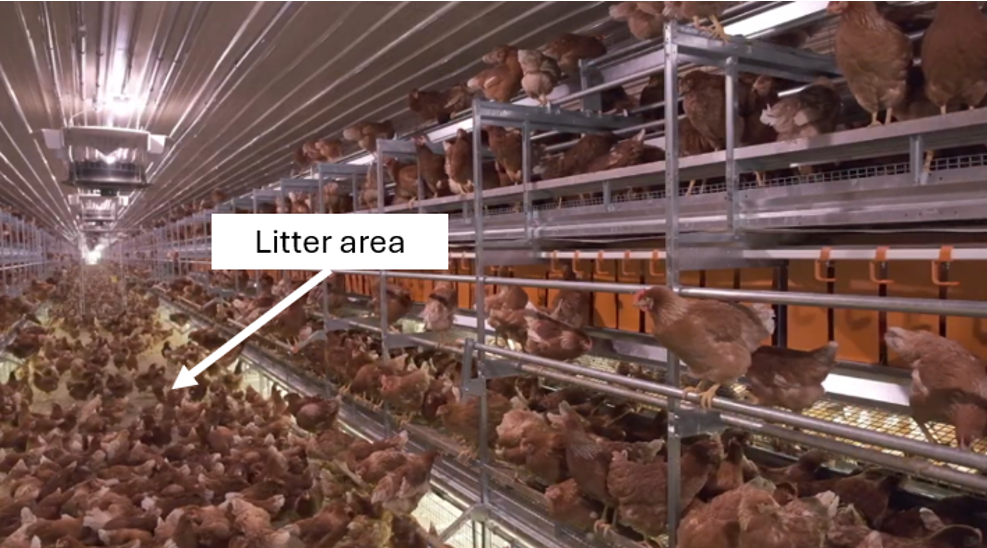
Figure 2. Example image of a multi-tier aviary system, specifically highlighting the litter area. Photo credit: Big Dutchman
Feeders allow hens access to feed and are essential to fulfil nutritional needs for maintenance and production (Figure 3). Adequate feeder space minimizes competition and ensures equitable access to feed, particularly in large group housing systems. Providing less feeder space linearly caused greater aggression and jostling at the feeder (Sirvonik et al., 2018).
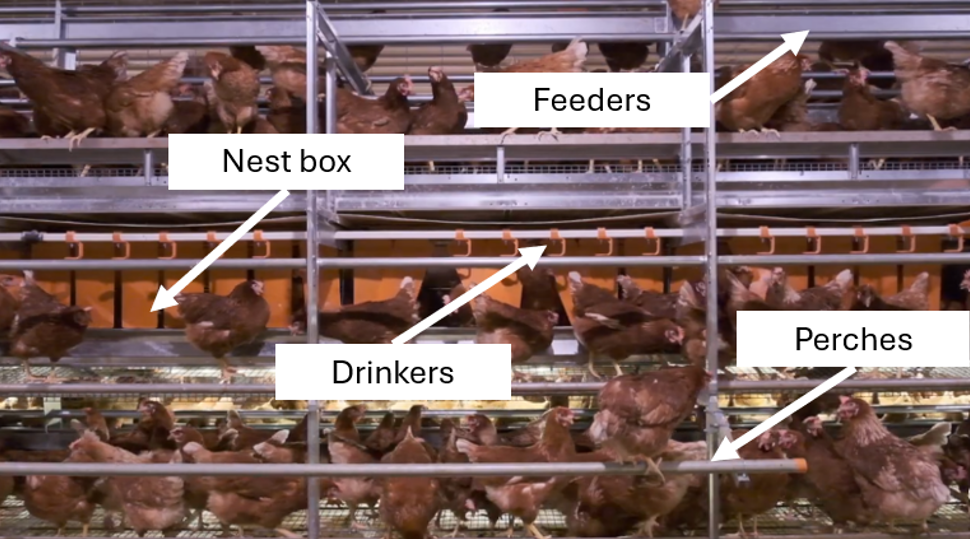
Figure 3. Example image of a multi-tier aviary, specifically highlighting the nest boxes, perches, drinkers, and feeders. Photo credit: Big Dutchman
Drinkers provide access to water and are essential for hydration and normal physiological function (Figure 3). In cage-free systems, reduced space allowance can limit access to drinkers and increase competition at resource points, potentially decreasing water intake and affecting welfare and production.
Perches provide elevated space for hens to perch and roost, while facilitating comfort behaviors like preening and building musculoskeletal strength (Figure 3; reviewed in Bist et al., 2023). Hens are motivated to rest in elevated locations, particularly at night (reviewed in Weeks & Nicol, 2006). Insufficient perch space may result in competition and displacement during roosting, potentially reducing rest (Duncan et al., 1992).
Nest boxes provide a dark, separate area for hens to lay their eggs. Hens are highly motivated to lay in secluded, sheltered spaces (Figure 3; Kruschwitz et al., 2008). Limited nest space or competition could result in distress from searching for an adequate place to lay eggs (Cronin et al., 2012) and eggs being laid on the floor (Kang et al., 2018), resulting in a loss of profit.
As time goes on, cage-free system designs continue to evolve. This results in ongoing discussion within the industry and welfare certification programs regarding the amount of space hens should have so that they can access these key resources. As a result, space requirements vary among animal welfare certification programs. See Table 1 for the standards used by four certification groups.
Table 1. Space requirements for welfare certification groups. Standards listed are for multi-tier aviary systems. *only steps 1-2 were used for this comparison; † Global Animal Partnership does not specify numeric feeder or drinker space allowances; standards state that hens must have unrestricted access to feed and water.
| Certifier | Floor | Litter area | Nest box | Perch | Feeder | Drinker |
| Certified Humane | 1 ft2/hen | 15% of available floor space | 9 ft2/ 100 birds |
6 in/hen | 2 in/hen | 1 nipple/ 12 hens |
| American Humane Certified | 1 ft2/hen | 15% of available floor space | 9 ft2/ 100 birds |
6 in/hen | 1.5 in/hen | 1 nipple/ 10 hens |
| Global Animal Partnership* | 1.5 ft2/hen | 0.6 ft2/hen | 10 ft2/ 100 birds |
5 in/hen | † | † |
| United Egg Producers Certified Cage-free |
1 ft2/hen | 21.6 in2/hen | 9 ft2/ 100 birds |
6 in/hen | 1.5 in/hen | 1 nipple/ 10 hens |
Future considerations for cage-free stocking density
Space allowance standards are commonly derived from the certifiers’ scientific advisory committees composed of researchers, veterinarians, and industry experts. The standards are applied across cage-free systems, regardless of bird strain or specific aviary design. However, different genetic strains use cage-free housing space differently. Brown and white strains differ in their distribution across tiers and litter areas, as well as in the timing and location of key behaviors such as roosting and litter use (Mench & Blatchford, 2014). In addition, strains also differ in the physical space required to perform basic behaviors. Brown hens required more space for standing and lying, while white hens used more space for wing flapping (Riddle et al., 2018). These findings suggest that space allowance standards based on average bird characteristics may not accurately reflect the spatial needs of all strains, so strain-specific differences should be considered in the development and application of future stocking density guidelines in cage-free systems.
Historically, in conventional and furnished cage systems, higher stocking densities in caged systems have been associated with worse welfare and production outcomes, like lower egg production (Vits et al., 2005), poorer feather condition (Weimer et al., 2019), and higher stress (Alig et al., 2025). However, cage-free aviaries allow hens to distribute themselves across vertical space and resource areas. welfare outcomes in cage-free systems may be more variable and less directly related to floor stocking density alone. Only a few studies investigated how stocking density impacts laying hen welfare and production outcomes in cage-free housing systems. Table 2 summarizes the reported effects of high stocking densities across several welfare and production measures.
Table 2. Effects of higher floor-space stocking density (> 1 ft2/hen) on welfare and production outcomes. Arrows indicate the direction of effect relative to lower densities (↑ increase, ↓ decrease, = no impact). Multiple symbols indicate mixed findings and superscript numbers correspond to the supporting references.
| Measure | Result | References |
| Mortality | Inconsistent | Nicol et al., 2006 |
| Plumage condition | ↑1 ↓2 | 1Nicol et al., 2006 2Nicol et al., 1999 |
| Eggs produced | = | Nicol et al., 2006 |
| Feather pecking | ↑ | Nicol et al., 1999 |
| Positive behaviors | ↓1 =2 | 1Carmichael et al., 1999 2Zimmerman et al., 2006 |
| Stress | = | Nicol et al., 2006 |
Overall, the effects of stocking density on welfare and productivity in cage-free systems appear inconsistent, suggesting that stocking density may not adequately explain variation in welfare and production outcomes. Hens do not necessarily distribute evenly among the available floor space in aviary systems (Ali et al., 2016).
Differences in tier configuration, perch placement, feeder and drinker access, usable vertical space, and social hierarchies may influence how hens distribute. Additionally, hens with injuries like keel bone fractures or footpad lesions may have restricted movement and remain near feeders or on upper tiers (Rufener et al., 2019). This could create persistent crowding in certain areas, increasing competition despite adequate floor space provided.
Consequently, space-related welfare concerns should not necessarily be addressed only through stocking density, but also in how hens use the housing environment, which requires further research.
Summary
American egg production is moving towards cage-free housing, which allow greater behavioral expression but also introduce new challenges. Evidence on the benefits of increased space and optimal stocking density remains inconsistent in these systems. Likely multiple factors influence these outcomes, like aviary design, genetic strain, and how hens use available space, highlighting the need for further research.
References
Ali, A. B. A., Campbell, D. L., Karcher, D. M., & Siegford, J. M. (2016). Influence of genetic strain and access to litter on spatial distribution of 4 strains of laying hens in an aviary system. Poultry science, 95(11), 2489-2502.
Alig, B. N., Anderson, K. E., Malheiros, D. M., Harding, K. L., & Malheiros, R. D. (2025). Assessment of the Effects of Stocking Density on Laying Hens Raised in Colony Cages: Part II—Egg Production, Egg Quality, and Welfare Parameters. Poultry, 4(3), 28.
Bist, R. B., Subedi, S., Chai, L., Regmi, P., Ritz, C. W., Kim, W. K., & Yang, X. (2023). Effects of perching on poultry welfare and production: a review. Poultry, 2(2), 134-157.
Campbell, D. L. M., Makagon, M. M., Swanson, J. C., & Siegford, J. M. (2016). Litter use by laying hens in a commercial aviary: dust bathing and piling. Poultry science, 95(1), 164-175.
Carmichael, N. L., Walker, W., & Hughes, B. O. (1999). Laying hens in large flocks in a perchery system: Influence of stocking density on location, use of resources and behaviour. British Poultry Science, 40(2), 165–176.
Cronin, G. M., Barnett, T. L. J. L., & Hemsworth, P. H. (2012). The importance of pre-laying behaviour and nest boxes for laying hen welfare: a review. Animal Production Science, 52(7), 398-405.
Dixon, L. M. (2008). Feather pecking behaviour and associated welfare issues in laying hens. Avian Biology Research, 1(2), 73-87.
Duncan, E. T., Appleby, M. C., & Hughes, B. O. (1992). Effect of perches in laying cages on welfare and production of hens. British Poultry Science, 33(1), 25-35.
Kang, H. K., Park, S. B., Jeon, J. J., Kim, H. S., Kim, S. H., Hong, E., & Kim, C. H. (2018). Effect of stocking density on laying performance, egg quality and blood parameters of Hy-Line Brown laying hens in an aviary system. European Poultry Science, 82, 1–13.
Kruschwitz, A., Zupan, M., Buchwalder, T., & Huber-Eicher, B. (2008). Nest preference of laying hens (Gallus gallus domesticus) and their motivation to exert themselves to gain nest access. Applied Animal Behaviour Science, 112(3-4), 321-330.
Lay Jr, D. C., Fulton, R. M., Hester, P. Y., Karcher, D. M., Kjaer, J. B., Mench, J. A., … & Porter, R. E. (2011). Hen welfare in different housing systems. Poultry science, 90(1), 278-294.
Mench, J. A., & Blatchford, R. A. (2014). Determination of space use by laying hens using kinematic analysis. Poultry science, 93(4), 794-798.
Nicol, C. J., Gregory, N. G., Knowles, T. G., Parkman, I. D., & Et., A. (1999). Differential effects of increased stocking density, mediated by increased flock size, on feather pecking and aggression in laying hens. Applied Animal Behaviour Science, 65(2), 137-152
Nicol, C. J., Brown, S. N., Glen, E., Pope, S. J., Short, F. J., Warriss, P. D., Zimmerman P. H., & Wilkins, L. J. (2006). Effects of stocking density, flock size and management on the welfare of laying hens in single-tier aviaries. British poultry science, 47(2), 135-146.
Riddle, E. R., Ali, A. B., Campbell, D. L., & Siegford, J. M. (2018). Space use by 4 strains of laying hens to perch, wing flap, dust bathe, stand and lie down. PLoS One, 13(1), e0190532.
Rufener, C., Abreu, Y., Asher, L., Berezowski, J. A., Sousa, F. M., Stratmann, A., & Toscano, M. J. (2019). Keel bone fractures are associated with individual mobility of laying hens in an aviary system. Applied Animal Behaviour Science, 217, 48-56.
Sirovnik, J., Wuerbel, H., & Toscano, M. J. (2018). Feeder space affects access to the feeder, aggression, and feed conversion in laying hens in an aviary system. Applied Animal Behaviour Science, 198, 75-82.
United States Department of Agriculture, Agricultural Marketing Service. (2026). Shell eggs: Monthly USDA cage-free shell egg report. https://www.ams.usda.gov/mnreports/pymcagefree.pdf
Van Liere, D. W., & Bokma, S. (1987). Short-term feather maintenance as a function of dust-bathing in laying hens. Applied Animal Behaviour Science, 18(2), 197-204.
Vits, A., Weitzenbürger, D., Hamann, H., & Distl, O. (2005). Production, egg quality, bone strength, claw length, and keel bone deformities of laying hens housed in furnished cages with different group sizes. Poultry science, 84(10), 1511-1519.
Weeks, C. A., & Nicol, C. J. (2006). Behavioural needs, priorities and preferences of laying hens. World’s Poultry Science Journal, 62(2), 296-307.
Weimer, S. L., Robison, C. I., Tempelman, R. J., Jones, D. R., & Karcher, D. M. (2019). Laying hen production and welfare in enriched colony cages at different stocking densities. Poultry science, 98(9), 3578-3586.
To view all issues of Poultry Press, click here.
Editor’s note: Content on Modern Poultry’s Industry Insights pages is provided and/or commissioned by our sponsors, who assume full responsibility for its accuracy and compliance.