



Highly pathogenic avian influenza A (HPAI) has challenged the US poultry sector since 2022. Two years later, it spilled over into dairy cows and soon thereafter was identified in dairy and poultry workers. Reports of HPAI infections have since broadened to other animals, including domestic cats and felines in zoos. This wider exposure and the influenza virus’s natural ability to reassort complicate prevention and control strategies.
The One Health approach, which encompasses human, animal and environmental health, is well-suited to address a disease issue such as HPAI. “It is a way of looking at things that’s more system-based,” said Meghan Davis, DVM, PhD, associate professor at John Hopkins Bloomberg School of Public Health and Engineering, adding that “Systems are dynamic, changing over time.”
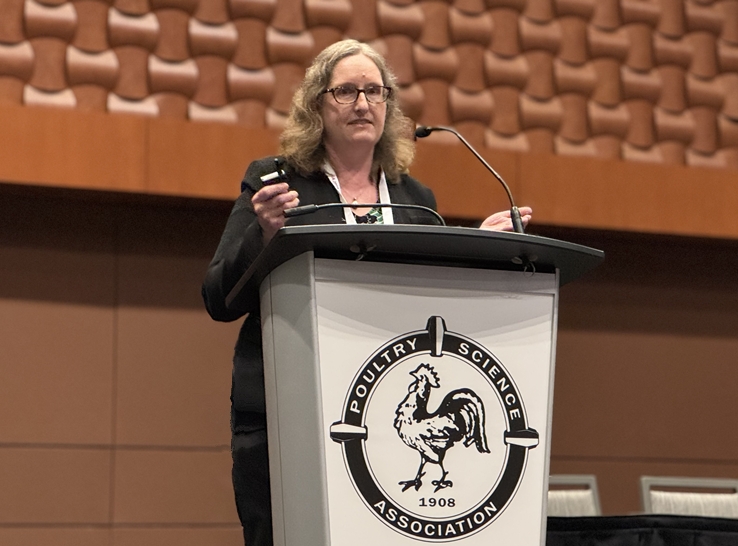
Systems within One Health are rooted in partner engagement and transdisciplinary science. “That means veterinarians are working with producers, virologists, economists, engineers and architects, etc.,” she explained in her presentation at the 2025 Poultry Science Association annual meeting.
A dairy veterinarian by training, Davis works at a National Institute for Occupational Safety and Health-funded (NIOSH) Total Worker Health Center. She conducted a scientific and policy analysis to evaluate the interconnectedness of the US poultry and dairy sectors, applying the One Health approach related to HPAI.
“We wanted to look at virus transmission risks and mitigation strategies related to workers, consumers and the public,” she pointed out.
Davis has also worked with the National Academy of Sciences to prevent spillover events, putting her in the thick of the HPAI dairy issue.
Diverse virus, diverse industries
The H5N1 influenza virus, which causes HPAI, is diverse. Although it initially hit domestic poultry, additional concern centered on potential reservoirs and future movement. “We had an unprecedented 175 million birds affected, but what concerns me most about H5N1 is its staying power and what it means in terms of forecasting,” Davis said. “We need to understand the local ecology but also how that interfaces with the ecology of wild animals.”
Due to exposure from migrating birds, H5N1 infections in poultry and other animals tend to occur in seasonal waves. “It’s important to consider the geographic proximity and what that means in terms of environmental exposure and other animals that can be affected,” she said.
Among the challenges posed by recent infections is that the dairy industry is structured differently from the poultry industry, with dairy much less integrated. “So, for 25,000 farms, you have 25,000 decision-makers,” Davis noted. “Because many are family farms, multiple people contribute to the final outcome.”
Dairies vary in size and design, and although there are regional clusters, production is spread out. “Dairy farms have very different biosecurity commitments than our poultry farms,” she added. “Even with a barn, the cows will have contact with wild birds, cats and rodents.”
Non-human vectors
Rodents are a common concern on farms and have been implicated as spillover species for many pathogens. “We have identified H5N1-positive mice on or in proximity of poultry and dairy farms,” Davis said. “What we don’t know is whether they are a reservoir, meaning if they could serve as a host to expose other animals.”
Cats, whether feral or companion, are another avenue that needs more clarity. In a California case, cows were showing mild symptoms of an infection, but cats were dying. “When cats get H5N1, it results in severe neurological disease, and that can signal there’s something else going on,” she said. “A cat with neurological symptoms that tests negative for rabies needs to be tested for H5N1.”
Davis pointed to a dairy worker who changed clothes at home, where the family’s cat rolled around in the clothes and contracted H5N1. “This leads to a public-engagement piece that we need to consider because people love their pets and they don’t want their cats getting sick,” she added.
Along with birds, more answers are needed to determine whether cats on farms, other mammals and rodents play a role in virus exposure and the related control strategies.
Human exposure
Humans are primarily affected through occupational contact, with more dairy workers than poultry workers infected, Davis noted. Working around a dairy cow’s udder presents the potential for splash exposure. “The virus gets on the worker’s hands, they put their hands to their face and it could lead to conjunctivitis, which we’ve seen quite a bit.”
For poultry workers, respiratory symptoms are more common. “We know the virus is in the feathers, feces and dust,” she added. “Birds move around, kick up the dust and expose the workers.”
The type and use of ventilation systems, as well as the way barns are engineered, play a role. Davis cited a poultry barn operating at high ventilation levels during depopulation, exposing workers to H5N1. Some workers were wearing personal protection equipment (PPE), some were not.
“PPE is a big challenge and something we need to think about moving forward,” she said. “Masks, face shields and goggles can be very uncomfortable. If PPE is not comfortable or doesn’t let you do your job, you’re less likely to use it.”
Knowing how to effectively communicate and engage the farm’s workforce is critical. Depending on the workers’ ethnic and language composition, handing them a pamphlet won’t cut it. “You have to engage with the workers, so they understand how to protect themselves and their families and pets,” Davis said. “You don’t want them to transmit the virus to another farm or into the community, because the virus’s ability to reassort is a big concern.”
Not all virus genotypes are the same. While the B3.13 genotype initially challenged workers, the D1.1 genotype emerged, causing more severe human cases and poultry losses. “An Ohio poultry worker was hospitalized with D1.1, and there was a Canadian with no known poultry contact but located in an area with positive-D1.1 farms,” she noted, adding that “there are also risks with backyard poultry flocks.”
There’s a revolving door of dairy cows moving between the US and Canada, Davis pointed out. “We like to sell and trade cows.”
Raw milk can expose the public to H5N1, she added. The virus can survive in meat and eggs, but the exposure risk is more limited. What people feed their pets can further extend the virus’s reach.
Surveillance challenges
Surveillance is key to knowing where the virus is and preventing further exposure to other farms and people. The two basic methods include active and passive surveillance.
Passive surveillance systems continuously collect data to identify where the virus is located. For humans, the CDC has handled this during flu season, testing respiratory samples and sewer effluent. Davis pointed out that this program has ended for H5N1.
For animals, the veterinarian is on the frontline reporting suspect cases. But that’s primarily for domestic animals. “We want to be able to do more remote sensing of the virus in waterfowl, to know where they’re going,” she added.
Active surveillance involves collecting samples from workers, animals, facilities and the environment. It often follows a positive case or detection. Although H5N1-infected birds get quite sick, cows present more of a detection challenge.
That’s what has prompted active surveillance through the national milk-testing strategy for bulk milk, as well as some carcass testing. “This allows us to pool big samples and then go back to individual dairies to see which farm could be infected,” Davis said.
Rural healthcare limitations present a surveillance gap on the human side. “If a worker is sick, are they going to a doctor? Will they be part of the influenza surveillance system?” Davis asked. “Probably not.
“We need to build collaborative systems that don’t rely on them coming to healthcare.” One way may be to set up passive surveillance to monitor dairy waste, she added.
A critical step moving forward is better data sharing on the animal side, including companion animals. Davis again pointed to a California outbreak that began despite a mandatory testing program. While some cows appeared sick, the cats were dying.
Actions to take
On the farm, Davis recommends starting with basic biosecurity steps for poultry and dairy personnel. Two such steps are to change clothes before leaving work and shower into and out of the facility.
“I come back to NIOSH and the hierarchy of controls, which is systemic thinking,” she said. “Identify where to put your money and effort for the most effective biosecurity strategies.” For example, make PPE readily available and train workers in its use. But be aware that they may not wear it correctly every time, and identify other biosecurity options.
One such option is to establish a workflow so that workers move from the lowest- to higher-risk areas. “Engage the workforce so that they are part of the solution to address H5N1,” Davis said.
Davis’s long-term goal is to have the poultry and dairy industries re-engineer facilities to better protect workers and animals.
More communication and data sharing across animal and human sectors must be a priority. “We need to think about different kinds of groups that need to be involved,” she said. “The One Health concept is a shared responsibility to address emerging challenges, and we lack that now.”
Veterinarians, of course, are on the frontlines. But the lingering question is, do we have veterinarians in all the right places? “We have a lot of veterinary-care deserts, especially in poorer areas,” Davis noted.
Bottomline, she emphasized the need for better control and mitigation strategies moving forward, because both cows and birds can be virus factories.