

USPOULTRY: Updated report shows poultry industry’s commitment to judicious antibiotic use
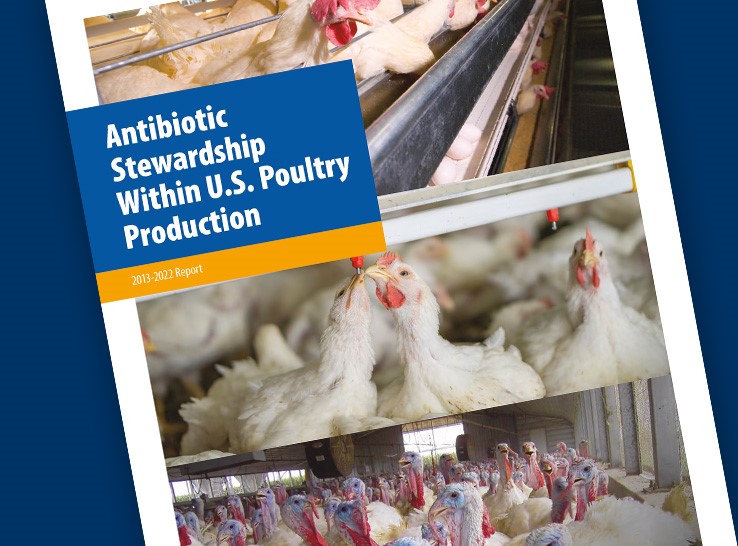
In December 2025, US Poultry & Egg Association (USPOULTRY) released an updated report quantifying the US poultry industry’s on-farm antibiotic use.
Low crude-protein diets are a well-proven practice to reduce diet cost and minimize excess nitrogen and excreta, thereby benefiting profitability, health and welfare in broilers and swine. However, the laying-hen industry is far behind in understanding the interaction and requirement of lower amino acids.
Recently, Campylobacter hepaticus was identified as the causative agent for chicken spotty liver disease (SLD), an illness which manifests as acute infectious hepatitis and causes a significant drop in egg production and high mortality in layer chickens. Researchers from Iowa State University, led by Orhan Sahin, DVM, PhD, are studying Campylobacter bacterins in the control of SLD.
University of Georgia researchers, led by Maricarmen Garcia, PhD, have developed a new genotyping assay for analyzing clinical samples of infectious laryngotracheitis virus (ILTV). Identifying the genotype of the outbreak-related virus and determining its genetic relationship to field or vaccine strains is key to diagnosing ILTV.
Broiler activities like locomotion and movement can be quantified using the broiler activity index (BAI), which has been associated with broiler leg health, productivity and physical conditions. However, current calculation procedures are not user-friendly, requiring extensive training. A new user-friendly web-based AI system could be the answer.
Clostridial dermatitis is an economically important disease of turkeys characterized by necrotic dermatitis and sudden death. Disease control strategies such as improved management and feeding probiotics have been only variably successful.
US Poultry & Egg Association (USPOULTRY) has released an updated report quantifying on-farm antibiotic use and demonstrating the industry’s commitment to antibiotic stewardship and disease prevention.
Adnan Ali Khalaf Alrubaye, PhD, University of Arkansas, and his research team conducted a research project that aimed to achieve lameness reduction in broiler chickens via in ovo immunization with an eBeam-treated multi-strain Staphylococcus vaccine.
Controlling ILT with vaccination is critical in maintaining healthy and profitable poultry production. Nearly all long-lived poultry in the US are vaccinated against ILT.
The US Poultry & Egg Association, National Chicken Council, National Turkey Federation and United Egg Producers have released an updated economic impact study that highlights the positive impact the poultry industry has on jobs, wages and federal and state revenue in the US.
Providing chicks a dark period from the time of placement in the broiler house is practical and affordable for broiler producers and has no apparent negative effects on broiler performance, according to research conducted by Garret Ashabranner, PhD; Brian Fairchild, PhD; and Michael Czarick, engineer at the University of Georgia.
A risk-assessment model for Salmonella demonstrates the potential public health benefit of focusing on chicken parts that are heavily contaminated with highly virulent serotypes of this bacteria instead of focusing on low-virulent serotype.
A multistate salmonella outbreak in the US due to the consumption of contaminated turkey products spurred a joint effort between the Centers for Disease Control and the turkey industry to identify an untraditional serotype of Salmonella, S. enterica serotype Reading (S. Reading).
Formaldehyde fumigation is a conventional method used to control total environmental microbial counts in the hatchery. However, according to Christine N. Vuong, PhD, University of Arkansas, this method does not differentiate between beneficial or pathogenic microbes.
Bird welfare is improved in cage-free layer systems compared to cage systems, but indoor air quality suffers in a cage-free environment due to higher bird activity.
Updated research supported by the US Poultry & Egg Association quantifying the US poultry industry’s on-farm antibiotic use shows further improvements in antibiotic stewardship and commitment to disease prevention within poultry production.
Multi-stage egg-incubation systems are challenging to manage. And too often, attempts to keep late-stage embryos from overheating create situations where early-stage embryos are at sub-optimal temperatures during critical developmental periods.
Hatchery sanitation is a continual issue in commercial poultry and has become a focus since the removal of antibiotics in production, according to Brian Jordan, PhD, associate professor at the University of Georgia.
In this age of “no antibiotics ever” farming, the re-emerging necrotic enteritis (NE) disease caused by Clostridium perfringens poses a major economically important health concern in poultry, particularly in broiler flocks, says Ravi Kulkarni, BVSc, assistant professor at North Carolina State University.
Light intensity has been shown to affect the activity of birds, but most studies have focused on constant light intensities to determine their effect on welfare.
Colibacillosis resulting from E. coli is arguably one of the major causes of morbidity, mortality and carcass loss to the poultry production industry worldwide, putting at risk one of the cheapest and most valuable sources of protein.
Pathogenic Enterococcus cecorum continues to plague the broiler industry, causing mortality from pericarditis and sepsis early in the growing period and lameness and paralysis late in the growing period.
Campylobacter jejuni is a leading cause of bacterial-derived gastroenteritis in the US, due to its ability to asymptomatically reside within the intestinal tracts of poultry.
Nikki Shariat, PhD, assistant professor at the University of Georgia, presented her research on profiling Salmonella serotypes through broiler processing at the 2023 IPPE.
Geneticists have been trying, with little success, to determine and select egg layer strains that will perform well in cage-free production systems because there are numerous unknown factors which influence a hens' performance.
Many turkey poults may experience poor starting performance for reasons that are not well understood. Turkey flocks may even suffer mortalities up to 3% within the first three weeks of life.
Chongxiao (Sean) Chen, DVM, PhD, assistant professor/extension specialist with University of Georgia Department of Poultry Science, presented his research on blackhead disease in poultry during the 2023 IPPE.
Modern Poultry is pleased to host
this editorial page on behalf of